A stone wayside shrine: what to decide before installation
A wayside shrine is rarely commissioned by an architect. More often it is a village community, a parish, or a family that has made a vow. That is exactly why the most important questions here are not about the stone.
What a wayside shrine is
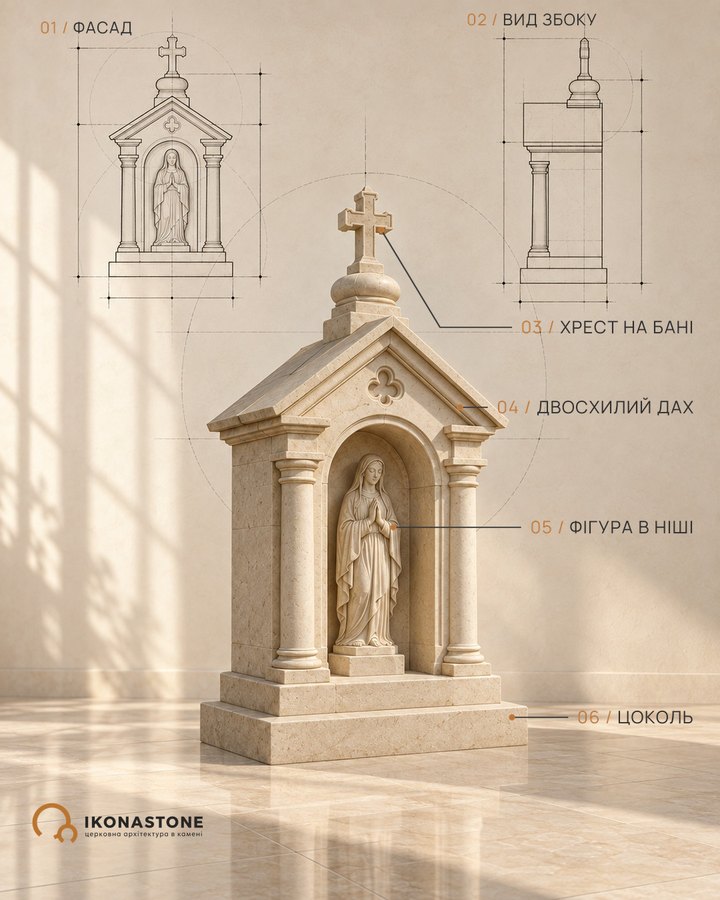
A chapel is a small Christian building without an altar. The first chapels were built over the graves of martyrs, and later also along roads, as memorials or in remembrance of a particular event. A wayside shrine is its smallest form: a pillar, a stele, or a small house-like structure with an icon or a sculpture in a niche. In the Orthodox and Greek Catholic tradition the Divine Liturgy is not celebrated in a chapel, because it has no altar table; at a wayside shrine people pray, and moleben and panikhida services are held.
How wayside crosses and shrines were put up in Volhynia, and what has survived to our time, we described in a separate article. This one is about what to decide today, before the first drawing.
First: whose land
A shrine stands on a specific plot: owned by the community, the parish, or a private owner. This determines who gives consent for its placement. The Law “On Regulation of Urban Planning Activities” classifies as small architectural forms small structures of decorative, auxiliary or other purpose, including memorial structures: gravestones, steles, obelisks. The placement of such forms is governed by the Law on the Improvement of Settlements, and it takes place by decision of the owner of the improvement site. Wayside shrines and religious buildings are not named directly in these lists. So the status of a particular shrine, whether it is a small form or a construction project, is best clarified with your community’s urban planning department before you place an order.
This is not a formality. A large chapel built without a design or permits on someone else’s land can be declared unauthorised construction by a court and ordered to be demolished. In 2023 this happened to a chapel of more than 130 m² on the grounds of the National Museum of the History of Ukraine in Kyiv.
Second: the blessing
A shrine is consecrated, and the consecration is agreed with the parish priest (among Greek Catholics, the paroch) and, where necessary, with the ruling bishop (eparch); the procedure differs from church to church. Sometimes this is remembered too late. In 2008 in Ivano-Frankivsk, in the Kniahynyn neighbourhood, a church court annulled the consecration of a cross and a stone for a future shrine because the priest had not asked the ruling eparch for permission; the cross was later removed. A conversation with the parish priest costs less than a lesson like that.
Third: stone and water
By the road a shrine stands in rain, snow and sun, so its worst enemy is water freezing in the pores of the stone. Restorers of wayside shrines in Poland point out that sandstone covered with oil paint or other layers that keep it from drying out retains moisture and accumulates salts; when the water freezes it expands and the stone cracks, while cement patches only do harm. Granite absorbs little water, which makes it a reliable choice outdoors. Sandstone and limestone also last for centuries, provided the stone is chosen correctly and has a chance to dry.
Modest or grand
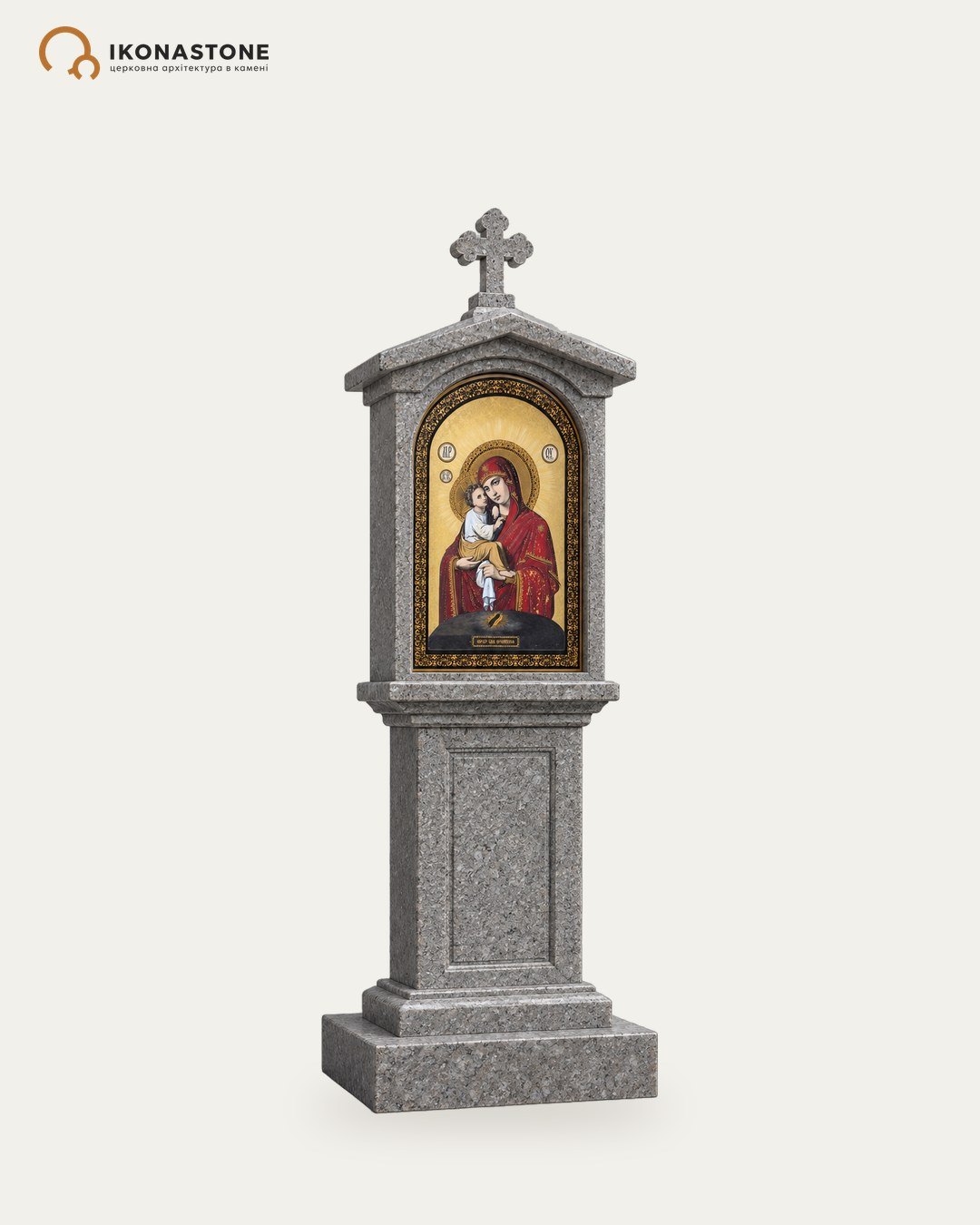
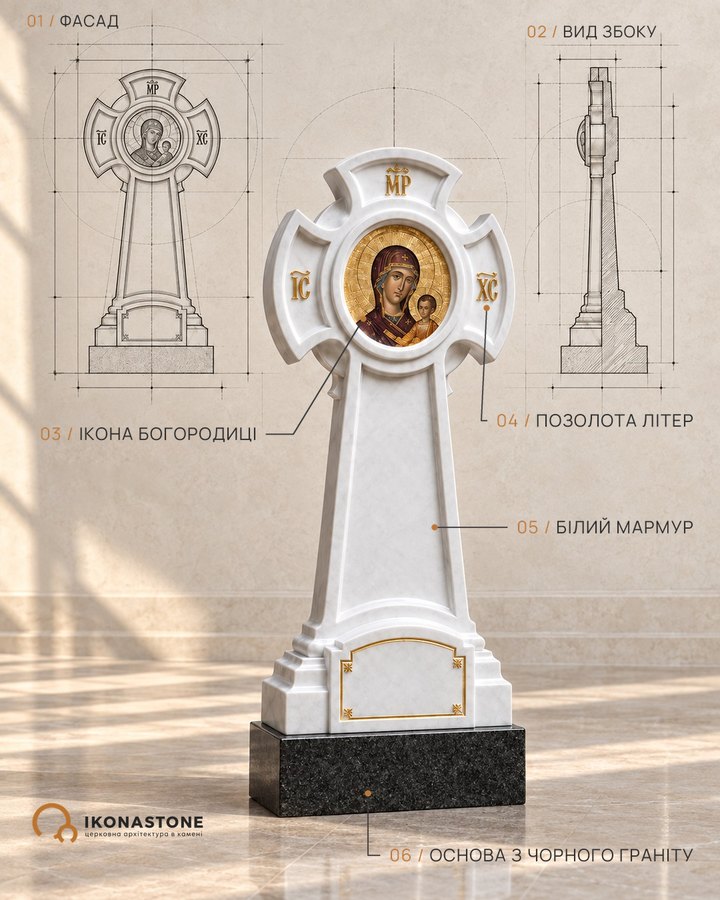
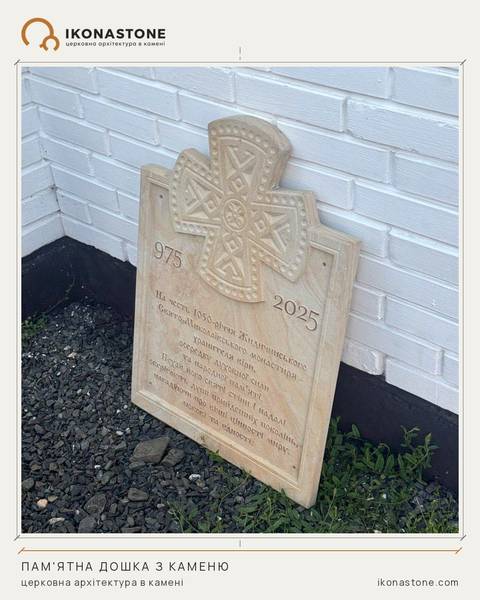
A wayside shrine does not have to be expensive. The simplest is a granite slab on a boulder, or a pillar with a glazed niche; a more elaborate one is a canopy on columns with a dome. We have collected various options, from simple steles to open shrines, among our chapel designs.
The stone will outlast everyone who set it up. So the questions of land and blessing are worth settling before the question of carving.