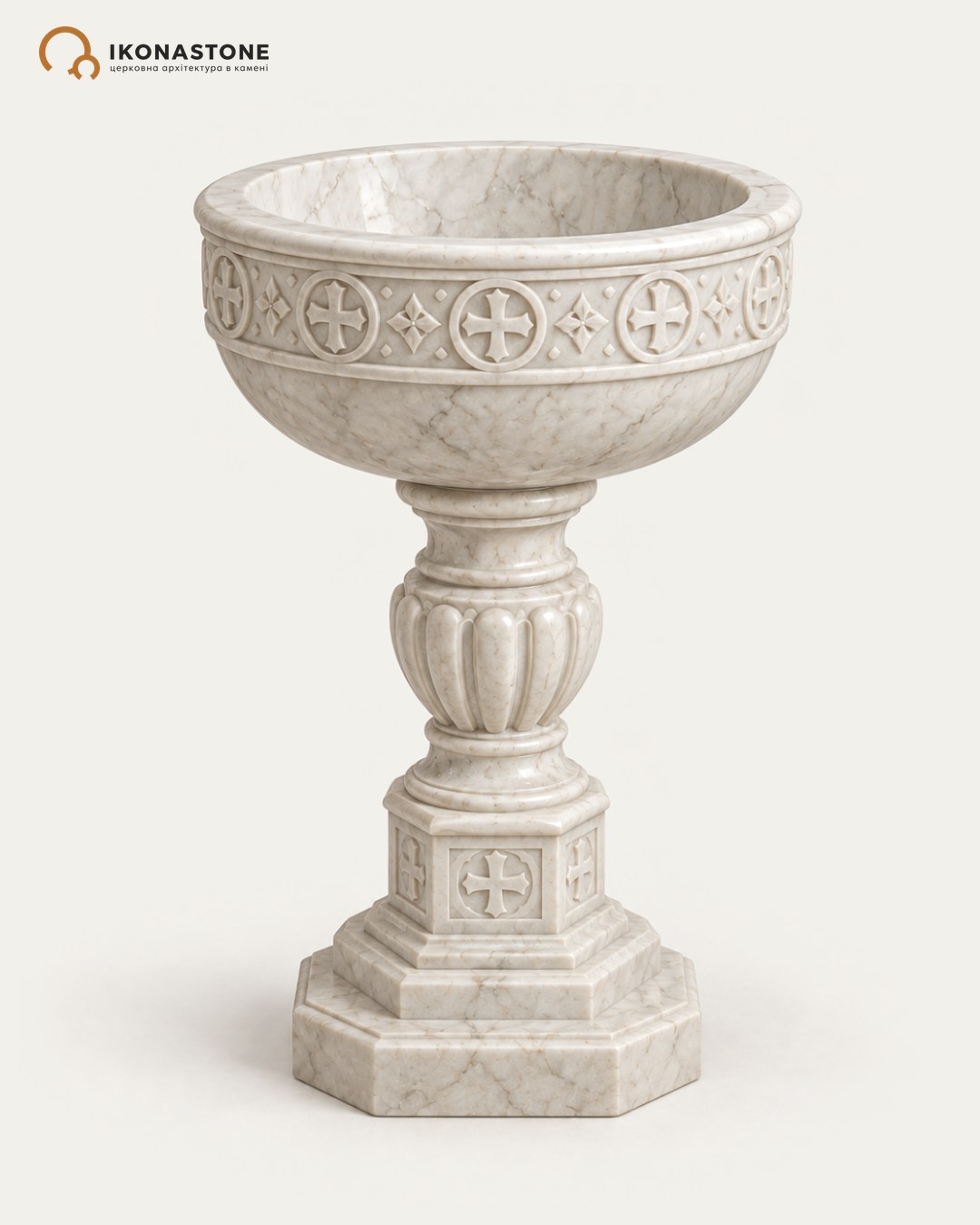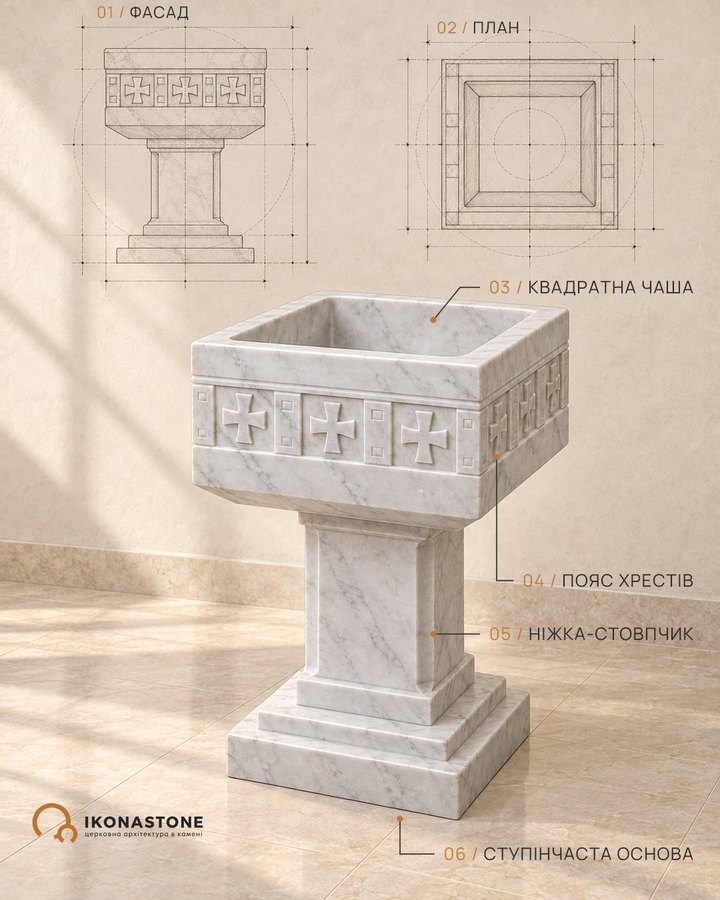
A stone baptismal font: eight sides, three immersions and one drain
A baptismal font and a holy water basin are almost the only things in a church that are made of stone in order to hold water. The rest of the stone merely tolerates it.
What the sources say
One of the oldest Christian texts, the Didache, or “Teaching of the Twelve Apostles”, sets out baptism step by step: in “living”, that is running, water. If there is none, in other water. If not in cold, then in warm. And if there is neither, pour water three times on the head in the name of the Father and of the Son and of the Holy Spirit. Even then the rule had a fallback, and the fallback concerned the water, not the substance.
In the Orthodox rite of Baptism the priest immerses the person in the water three times. Hence the first requirement for a font: it must be deeper than a decorator would like.
Why eight
In Milan, beneath the square in front of the cathedral, the remains of the octagonal baptistery of San Giovanni alle Fonti were excavated. Scholars believe that this is where Saint Ambrose of Milan baptised Saint Augustine on the Easter night of 387. An inscription attributed to Ambrose explains the shape: the temple has eight niches, the font is octagonal, and it is fitting for this number to be the basis of the hall of holy baptism.
The eighth day is the day after the completed week of creation, an image of the Resurrection and of new life. So an octagonal font is not an ornament but an argument.
What to decide before drawing
Now to what concerns the stonemason.
First, who will be baptised. A font for infants is a basin on a stem. A font for adult immersion is closer to a small pool. The sixth-century marble font in Hagia Sophia in Constantinople, according to one researcher, held about 12 cubic metres and could take up to ten adults. Every particular church lies somewhere between these extremes.
Second, the water. Where it is poured from and where it is poured out after the Sacrament is decided by the parish priest according to church practice. For the stonemason this means an opening, a drain and a sloped bottom, all of which go into the drawing before cutting. Granite can be drilled later, but that is a repair, not a design.
Third, the joints. Early fonts were often built from large stone blocks fitted so tightly that the joints held water, and the basin itself was preferably cut from a single stone. The logic is the same today: the fewer joints, the fewer places where water will look for a way out.
Fourth, the stone. It will stand in water for years, so it is chosen by how the rock copes with moisture, not only by colour. We have written separately about how granite, marble and limestone behave.
We design fonts and holy water basins like these for a specific church and its parish priest.
The water stays in the font for a few minutes. The stone stays for centuries. That is why the drain deserves thought before the crosses on the band.