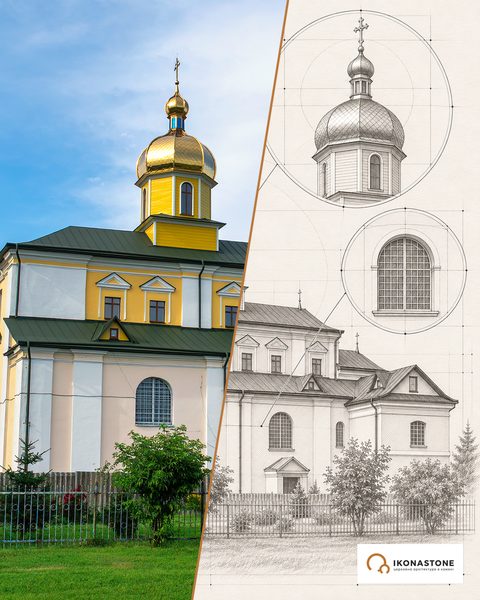
The Holy Cross Exaltation Church in Lutsk: the apse that outlived the church
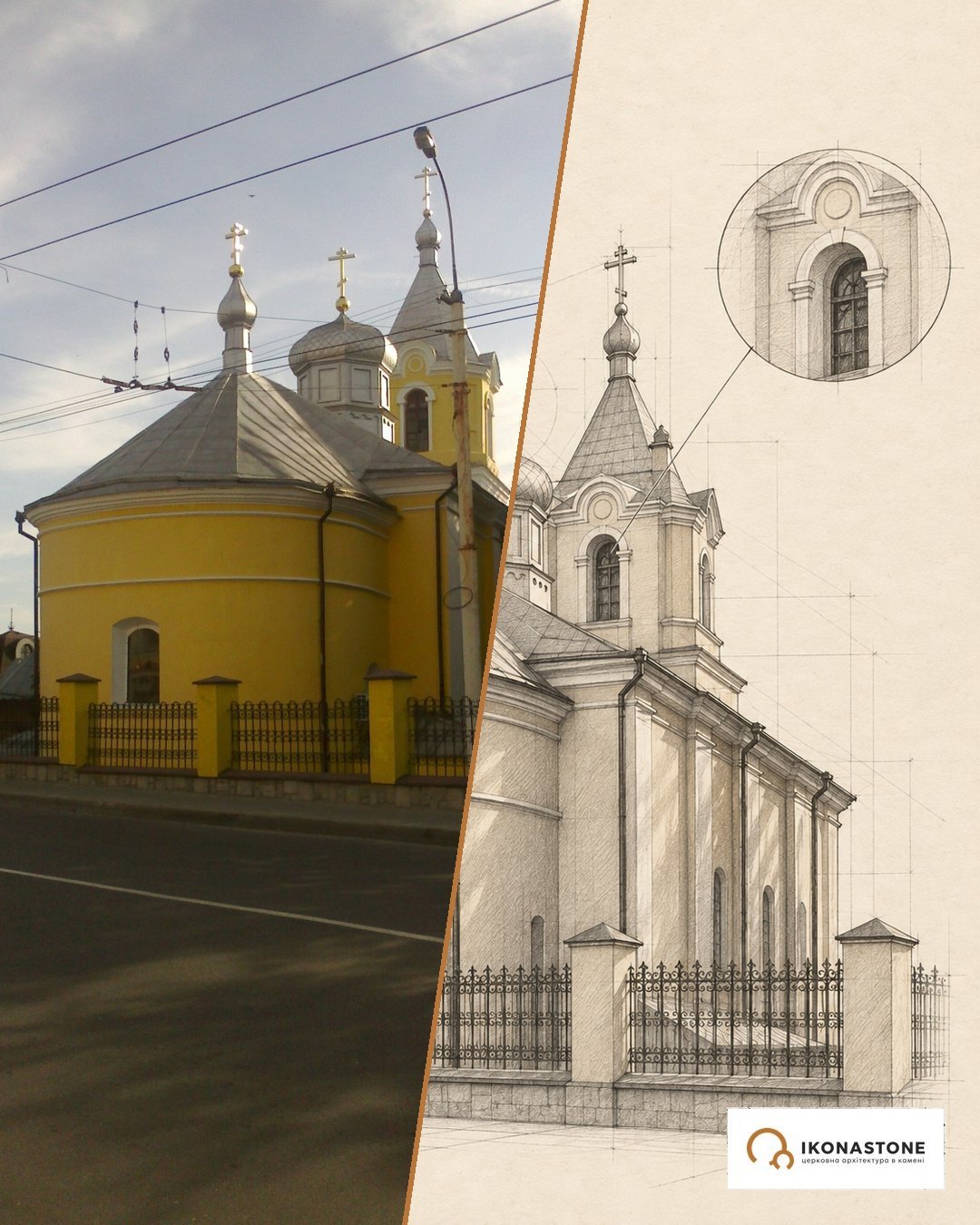
Of the great church of the Lutsk Brotherhood, only the sanctuary part remains. But look closely at the buttresses on either side of the apse and you can imagine the weight they once bore.
At a glance
| Address | Lutsk, 2 Danyla Halytskoho Street; the monastery is at 5 Yova Kondzelevycha Street |
| Built | 1619–1634 (according to the Great Ukrainian Encyclopedia; according to other data, restored) |
| Founders | The Lutsk Brotherhood; donors included Halshka Hulevychivna and the Hulevych, Puzyna, Semashko and Chetvertynsky families |
| Type | originally a three-nave masonry church with a porch and a tower; now single-domed, with an apse and two buttresses |
| Rebuilding | 1888–1890 (from the old apse) |
| Status | architectural monument of national importance (protection No. 79) |
The story in plain words
A short account, about a 5-minute read. The full chronology, with all dates, disputes and sources, is below in the "Chronology" section.
A brotherhood begins with a hospital (1617–1620)
The Lutsk Brotherhood of the Exaltation of the Holy Cross was formed in 1617. They were townspeople and nobles who joined together to protect their faith and help people. In 1619 King Sigismund III allowed them to rebuild the burnt-out “Ruthenian hospital” and to put up a church and a school. The Volhynian nobles, the “elder brethren”, entrusted oversight to the Lutsk townspeople, the “younger brethren”.
In June 1620 the patriarch permitted the building of a church with the right of stauropegia, that is, subordination directly to the patriarch. Some publications call him the Patriarch of Jerusalem, others of Constantinople. A wooden church and school, by some accounts, were already standing that same year.
The brick church (1629–1640s)
When exactly the brick church was built, the sources dispute. Some give 1619–1634 and add that it may not have been built but restored. Others say 1629–1632, still others the 1630s or 1630–1640s, and by one source construction was finished only in the 1640s. According to Wikipedia, the brick church was raised on land that Prince Yurii Puzyna bought and gave to the brotherhood. Halshka Hulevychivna gave the brethren 1,000 zlotys, and 500 of them went to finish the church.
The church never stood alone. In 1635 the printer Telytsia gave the brotherhood all his printing equipment, and the brotherhood gained its own press. In 1645 the king permitted a hospital to be founded. By 1647 a two-storey brick monastery had risen alongside, with a hospital, a school, a library, a press and cells. So the complex took shape on the edge of the Market square and Bratskyi Bridge.
The school taught grammar, poetics, rhetoric, dialectics, arithmetic, theology and church singing. One of the teachers was the icon painter Yov Kondzelevych. According to Wikipedia, in its heyday the school was a leading one among such schools.
Decline and fire (1713–1864)
From 1713 the brotherhood declined, and the complex passed to the Basilians, a monastic order. Around 1731 the centre went from Orthodox to Uniate. In 1761 a fire damaged the buildings, and they were restored until 1774.
In 1803 a new fire broke out and the church was ruined. While waiting for rebuilding, the walls cracked and the vaults partly collapsed. The ruins stood for more than half a century. In 1864 they were sold at auction as building material and taken down all the way to the altar part. That part survived. According to Wikipedia, some of the bricks went to the bell tower of the Church of the Protection.
A new church on the old apse (1871–1890)
On 2 February 1871 the revived brotherhood officially got to work. Among its aims was to restore the church to its former appearance. In 1888 a chapel was set up on the site of the ruins. In 1890 a small single-domed church was rebuilt, incorporating the old 17th-century apse with its arcaded frieze. This is roughly what we see today.
The church was consecrated on 26 August 1890. The next day Emperor Alexander III came with his family for a litia, and the Lutsk brother Petro Kosach was to meet him. The emperor, it is said, donated 3,000 roubles.
Between the wars and under Soviet rule (1921–1964)
In 1921–1939 the church was an important centre of the UAOC. Its rector Pavlo Pashchevskyi was the first in Lutsk to serve the liturgy in Ukrainian. The head of the brotherhood, the architect Serhii Tymoshenko, changed the silhouette of the dome and the west pediment in 1935–1937. In the 1930s the monument was partly restored to his design.
After the war the brotherhood ceased its activity. In 1957 a planetarium was set up in the church, and in 1964 a two-storey block was added to it.
The return (1990 – today)
In 1990 the city council handed the building to the Volhynian regional Brotherhood of St Andrew the First-Called. Since 1992 it has belonged to the Orthodox Church of Ukraine. In 2010 the church was repaired. Wikipedia notes that the repair brought in elements foreign to a Ukrainian church. Recreating the great church was planned back in the late 1990s, but the project was not carried out.
On 27 September 2011 the Museum of the History of the Lutsk Brotherhood of the Exaltation of the Cross opened in the former monastery building. What remains of the great church today is the altar part. But if you look closely at the buttresses on either side of the apse, you can imagine what weight they once carried.
Glossary
| Word | What it means |
|---|---|
| Brotherhood | a union of townspeople who together support a church, a school and a hospital |
| Hospital | in the old days, a shelter and infirmary for the poor and sick |
| Stauropegia | subordination of a church or brotherhood directly to the patriarch, not to the local bishop |
| Basilians | a Greek Catholic monastic order |
| Uniate | recognising the authority of the Pope while keeping the Eastern rite |
| Apse | the semicircular projecting part of a church where the altar stands |
| Buttress | an outer projection of a wall that carries its weight |
| Arcaded frieze | a band of a row of small arches decorating a wall |
| Litia | a short service with a prayer for the dead |
Timeline
The numbers in square brackets are source numbers from the list at the bottom of the page. The note “according to …” means that the fact is confirmed by only one source. The “Legends” section contains legends and traditions: they are recorded in the sources but not documentarily confirmed.
Founding of the brotherhood and construction
- 23 August 1617
The will of the monk Hryhorii Mykulych mentions a brotherhood that is “now being founded in Lutsk”. The history of the brotherhood is counted from 1617, from the first page of the brotherhood's “Catalogue”. [2, 3, 7]
- February 1619
King Sigismund III issued a charter: to rebuild the burnt-down “Ruthenian” almshouse (hospital) and to build a church and a school. RISU gives the date as 20 February, O. Shtanko (2017) as 2 February. [2, 3, 4]
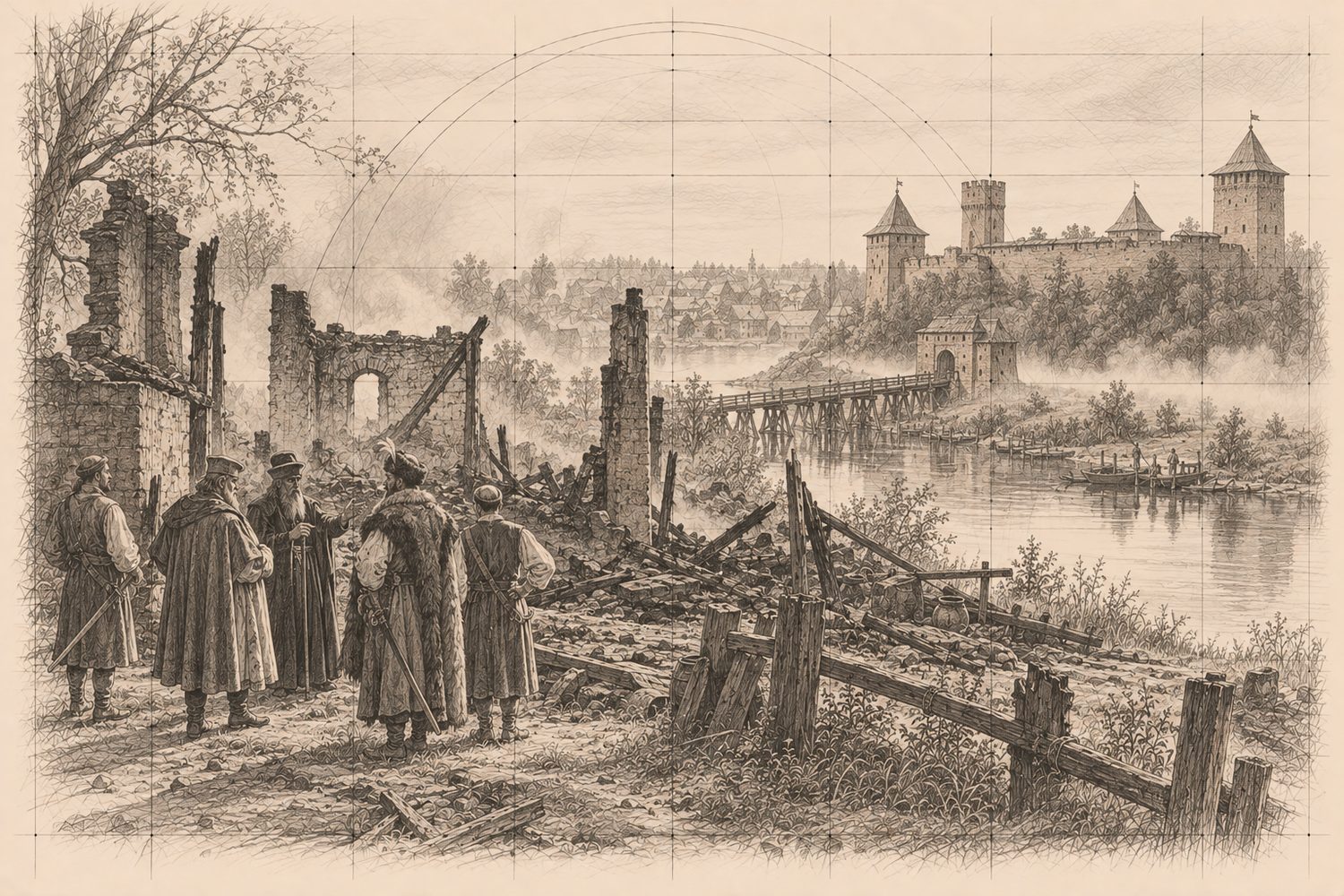
1619: the brotherhood is founded. Illustration: IKONASTONE - 1 September 1619
The Volyn nobility (the “senior brethren”) entrusted supervision of the brotherhood's institutions to the Lutsk townspeople (the “junior brethren”); according to RISU, the document was entered in the Lutsk town court book. [2, 3, 4]
- 1619–1620
The Encyclopedia of Ukraine dates the first brotherhood church to 1619–1620; according to Wikipedia (en), in 1620 the brotherhood built a wooden church and school. [8, 10]
- June 1620
Patriarch Theophanes III of Jerusalem permitted the building of the Church of the Exaltation of the Holy Cross with the right of stauropegion (direct subordination to the patriarch). Some publications call Theophanes a patriarch of Constantinople. [2, 3, 4, 5, 11]
- 1623
Cyril Lucaris, Patriarch of Constantinople, confirmed the stauropegion and the statute of the brotherhood. [2, 7]
- 1624
The statutes of the brotherhood school survive from this year; according to Shtanko, a three-day examination was held before admission to the school. [4, 20]
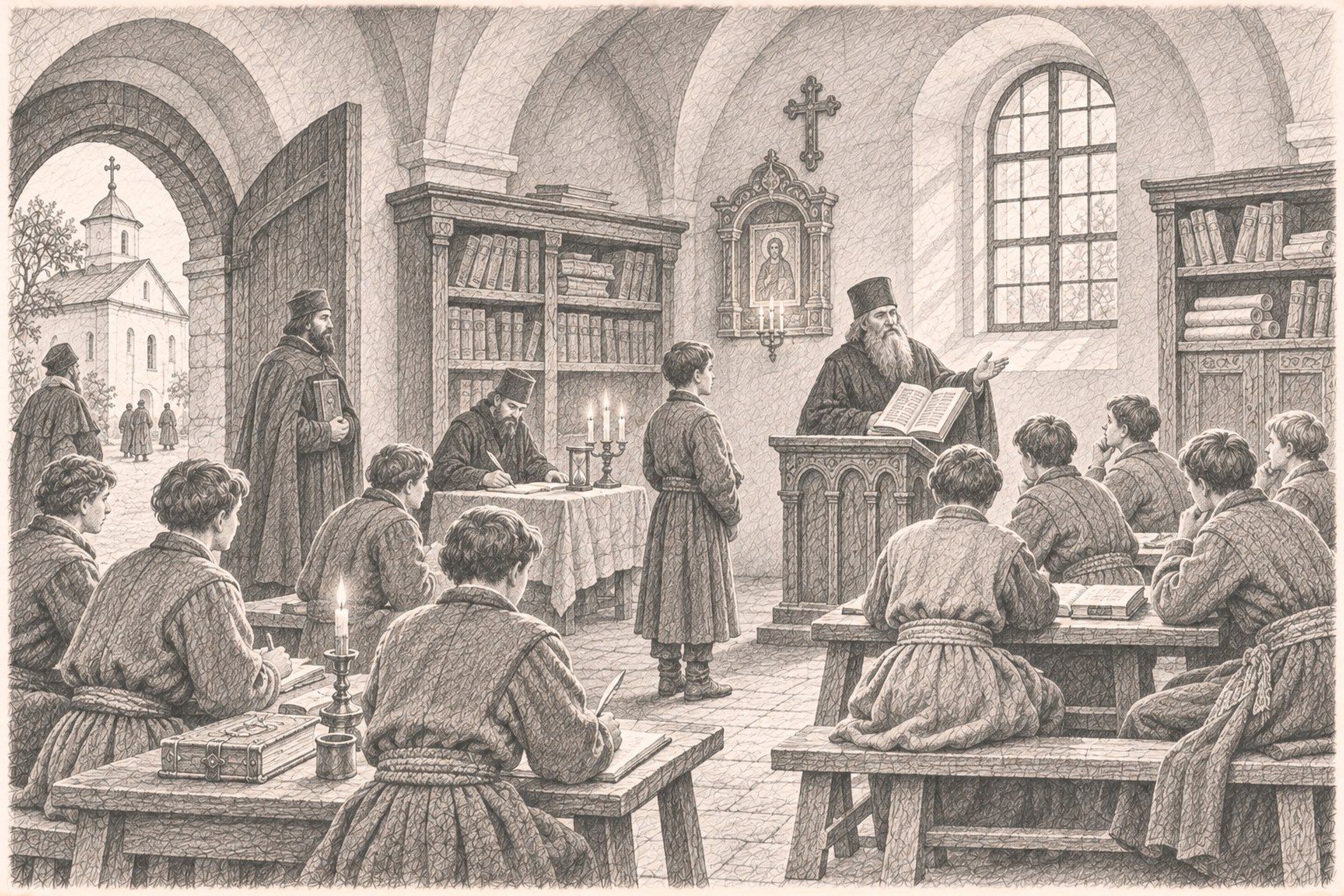
1624: the brotherhood school (conjectural reconstruction). Illustration: IKONASTONE - 1628
The itinerant printing house of Pavlo Domzhyv Liutkevych Telytsia published in Lutsk the collection “Lament for the Devout Late Father Ioan Vasylevych”. [2, 4]
- 1629–1640s
The sources give the time of construction of the masonry church differently: the Great Ukrainian Encyclopedia says 1619–1634 (according to other data, the church was restored); Volynski Novyny 1629–1632, built by the brethren themselves; Nasha Parafiia and Wikipedia (en) the 1630s; the Volyn Regional Museum of Local Lore and Via Regia the 1630s–1640s; according to RISU, construction was completed in the 1640s. [1, 2, 3, 5, 10, 11, 14]
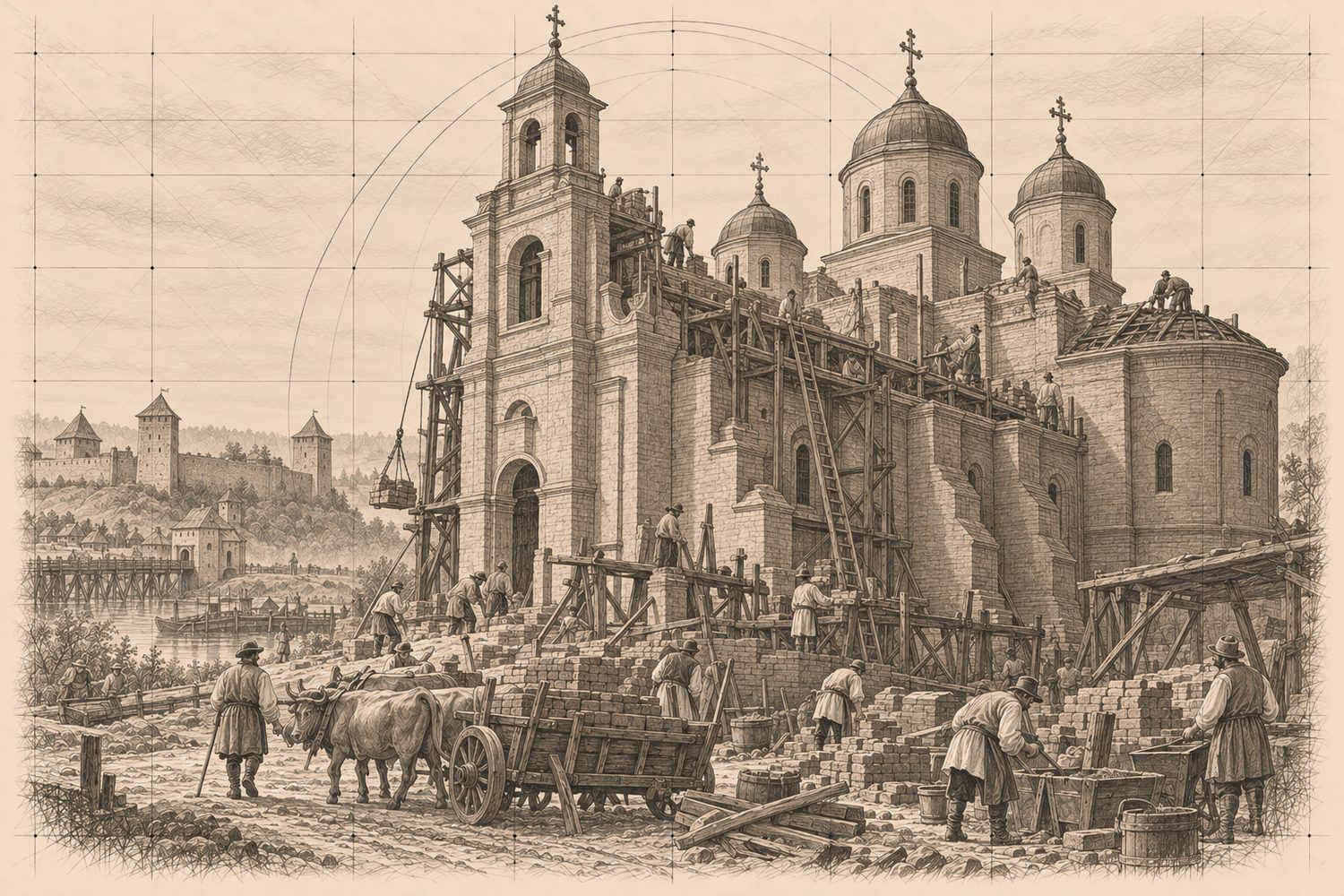
1630s: building the masonry church. Illustration: IKONASTONE - 1635
Telytsia gave the brotherhood all his printing equipment; from then on the brotherhood had its own printing house. [4, 10]
- 1642
Halshka (Elizabeth) Hulevychivna died in Lutsk; she was the founder of the Kyiv Epiphany Brotherhood and its school. According to the Great Ukrainian Encyclopedia, she gave the Lutsk brethren 1,000 zlotys, of which 500 went to completing the church. [1, 15]
- 11 December 1645
King Wladyslaw IV granted Oleksandr Mozelli a privilege to found a hospital on the Zubtsiv land. By 1647 a two-storey masonry monastery had been built, with a hospital, school, library, printing house and cells. [3, 4, 10]
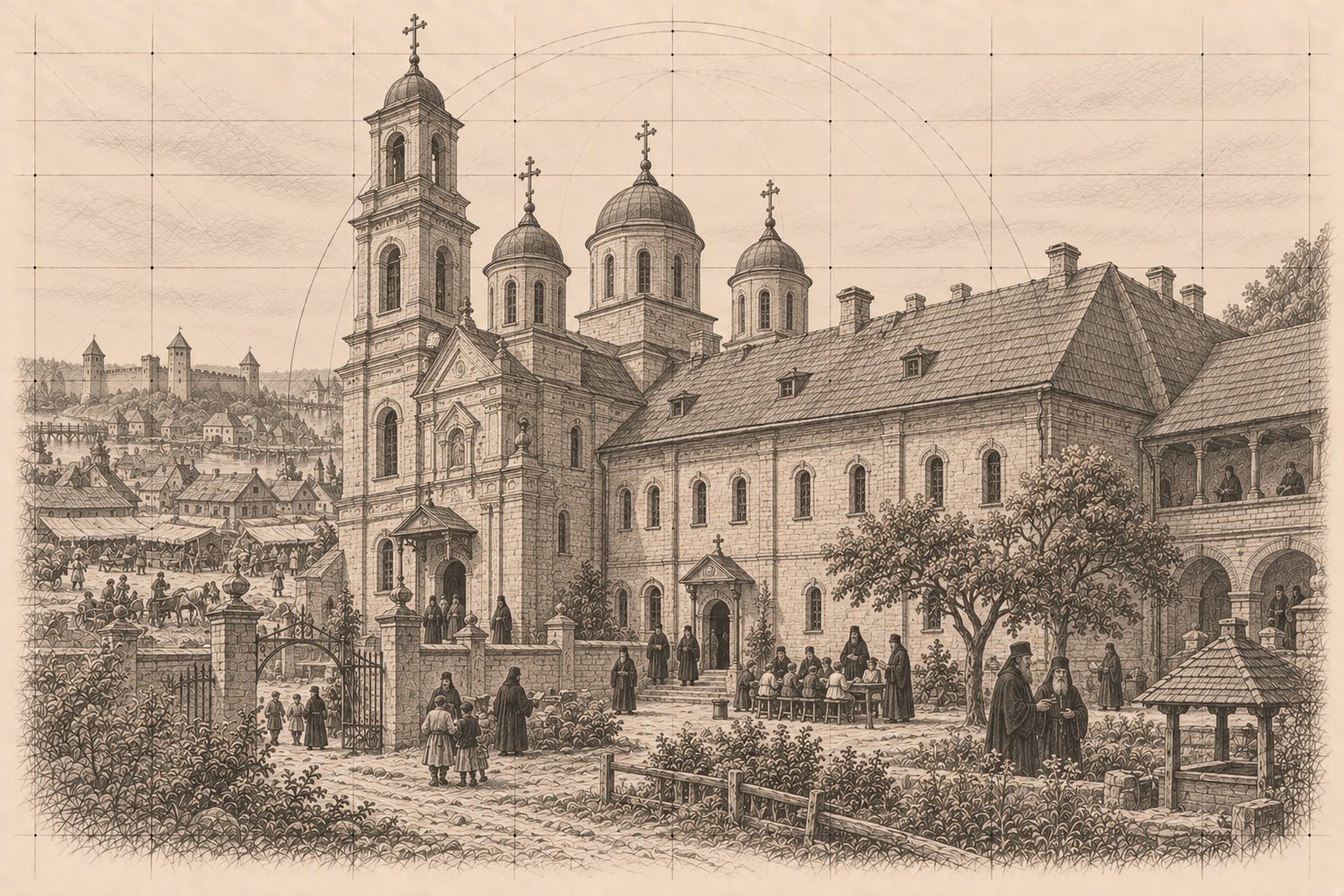
Around 1647: the brotherhood monastery and school. Illustration: IKONASTONE - 1 September 1648
Cossack troops entered Lutsk; according to the authors, this had a negative effect on the brotherhood. In December 1648 Prince Yurii Puzyna, the brotherhood's chief patron, died. [3, 4]
Decline and the Basilians
- 1680
Danylo Bratkovskyi was chosen for the delegation of the Lutsk Brotherhood to King John Sobieski, according to RISU. [2]
- 1697
Bratkovskyi's Polish-language collection “The World Viewed in Parts” was published in Kraków. [16, 17]
- 25 or 26 November 1702
Danylo Bratkovskyi was executed in Lutsk for a proclamation calling for an uprising and for taking part in the Palii uprising. The sources disagree on the date: Radio Svoboda says the 25th, RISU and the Encyclopedia of Ukraine the 26th. [2, 16, 17]
- 1713
The brotherhood declines; the complex passes to the Basilian order. [1, 9, 10]
- Around 1731
The centre ceases to be Orthodox and becomes Uniate. [2, 3, 10]
- 1761–1774
A fire in 1761 damaged the complex; rebuilding was completed in 1774. [1, 10]
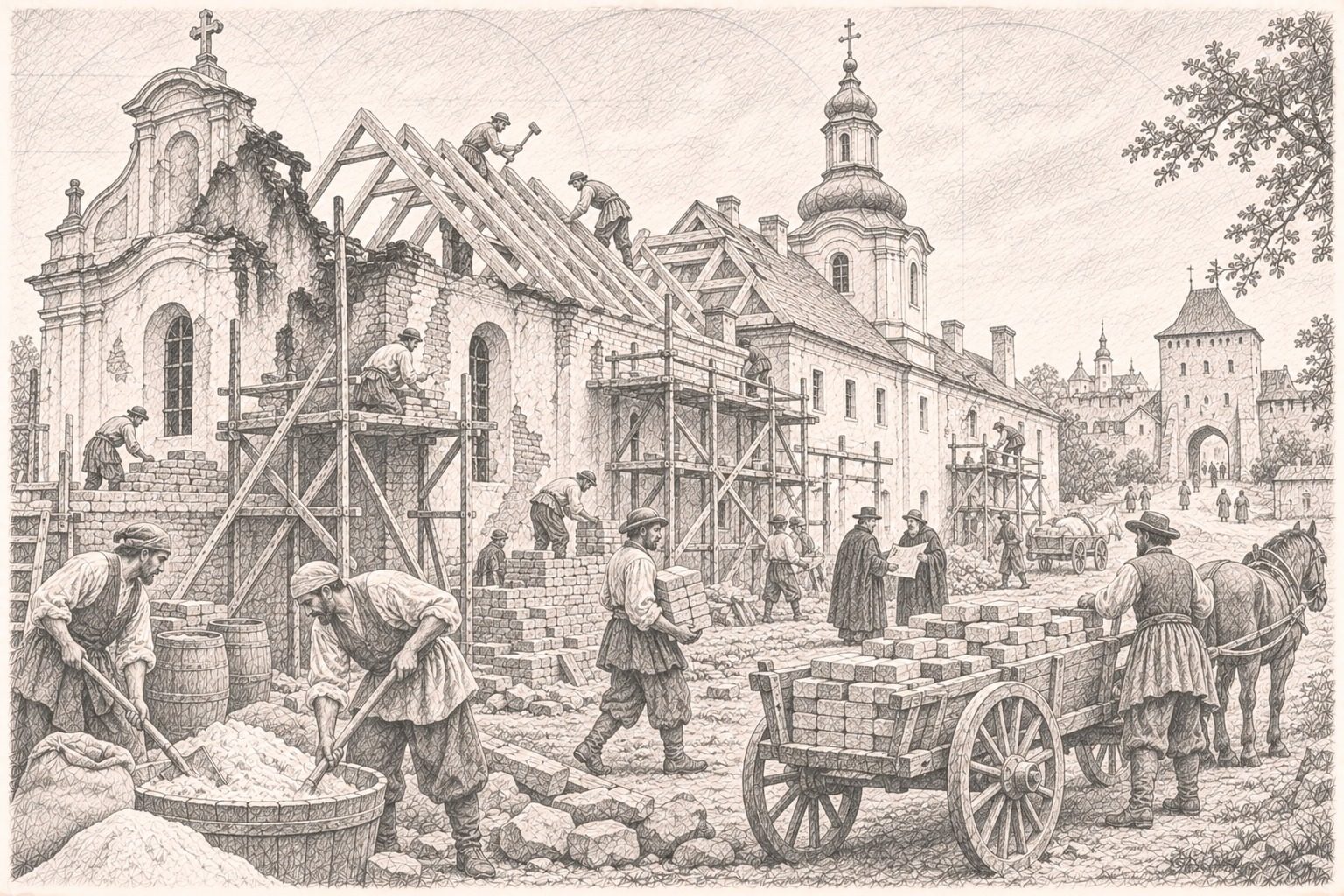
1761–1774: rebuilding after the fire (conjectural reconstruction). Illustration: IKONASTONE - 1803
A fire destroyed the church. The abbot Hryhorii Kornakovskyi compiled a detailed description of the church in 1806, according to Andrii Boiarchuk. [1, 5, 11]
Ruin and rebuilding
- 1864
The ruins of the church were sold at auction as building material and dismantled down to the sanctuary part, according to the Great Ukrainian Encyclopedia. The same year Emperor Alexander II approved rules that favoured the creation of brotherhoods, according to O. Alioshyna. [1, 13]
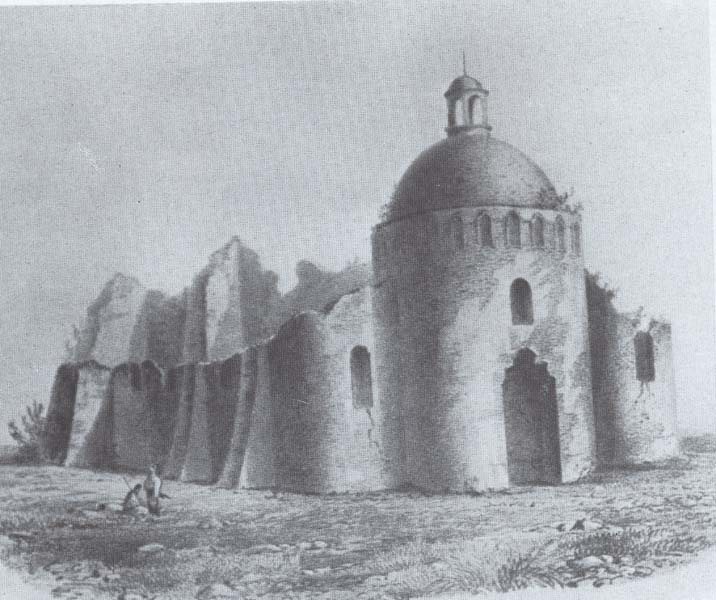
The brotherhood church in the 19th century. Drawing by Dmytro Strukov. Wikimedia Commons, public domain 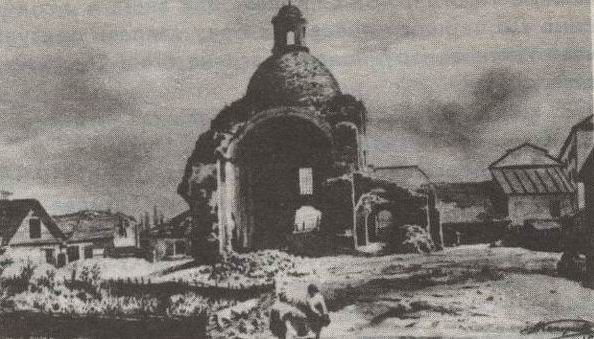
The ruins of the brotherhood church. Drawing by Jan Konopacki, 1879. Wikimedia Commons, public domain 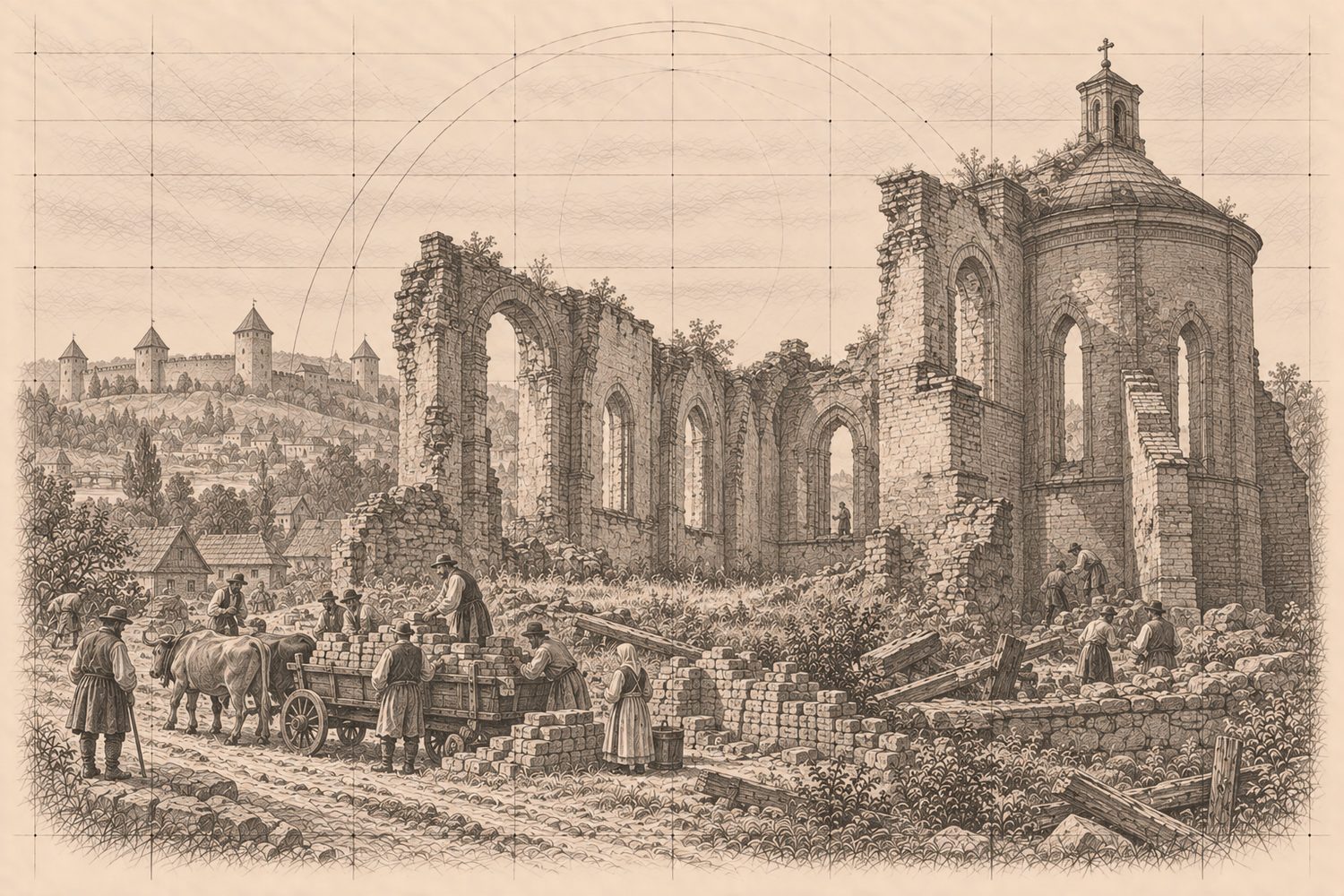
1864: the ruins are dismantled. Illustration: IKONASTONE - 2 February 1871
The revived Lutsk Brotherhood of the Exaltation of the Holy Cross officially began its activity; among its tasks was “restoring the brotherhood Church of the Exaltation of the Holy Cross to its former appearance”. [9, 13]
- 1873
The brotherhood received legal confirmation of its rights, according to the Encyclopedia of Modern Ukraine. [9]
- 1888–1890
In 1888 a chapel was fitted out on the site of the church, and in 1890 a small single-domed church was rebuilt that incorporated the old 17th-century apse. [1, 9, 10]
- 26–27 August 1890
According to Boiarchuk, the restored church was consecrated on 26 August, and the next day Emperor Alexander III arrived with his family for the litia; the Lutsk brother and marshal of the nobility Petro Kosach was to come out to meet him. Wikipedia (en) adds that the emperor donated 3,000 roubles. [5, 9, 10]
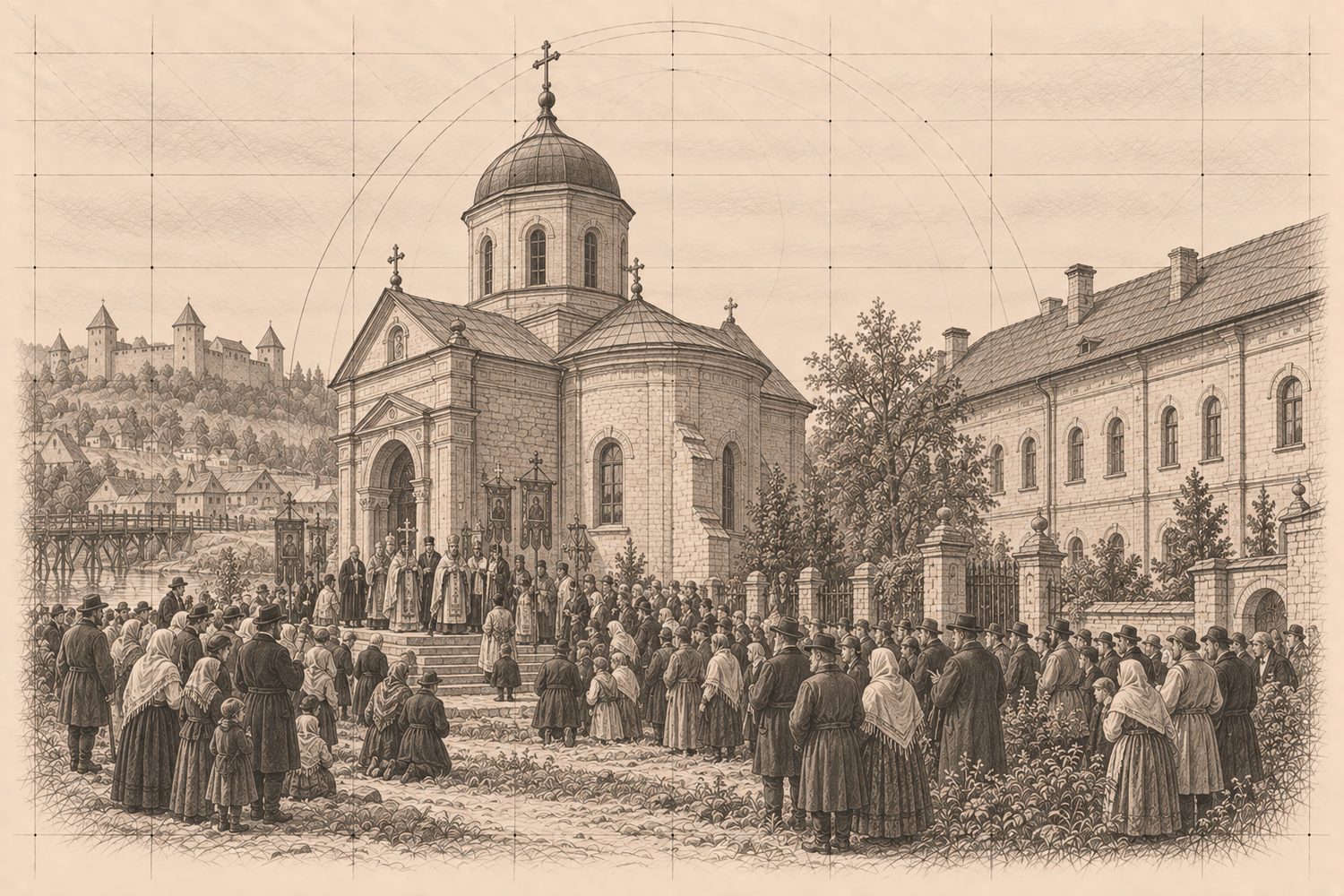
1890: the rebuilt church is consecrated. Illustration: IKONASTONE - 1906
A parish church school was opened at the brotherhood, and later evening classes for adults. [9, 13]
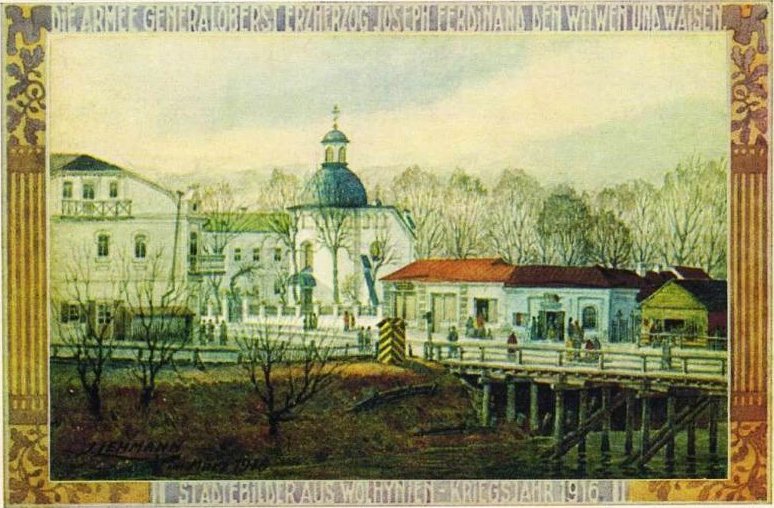
Lutsk on a postcard by J. Leman, 1916. Wikimedia Commons, public domain 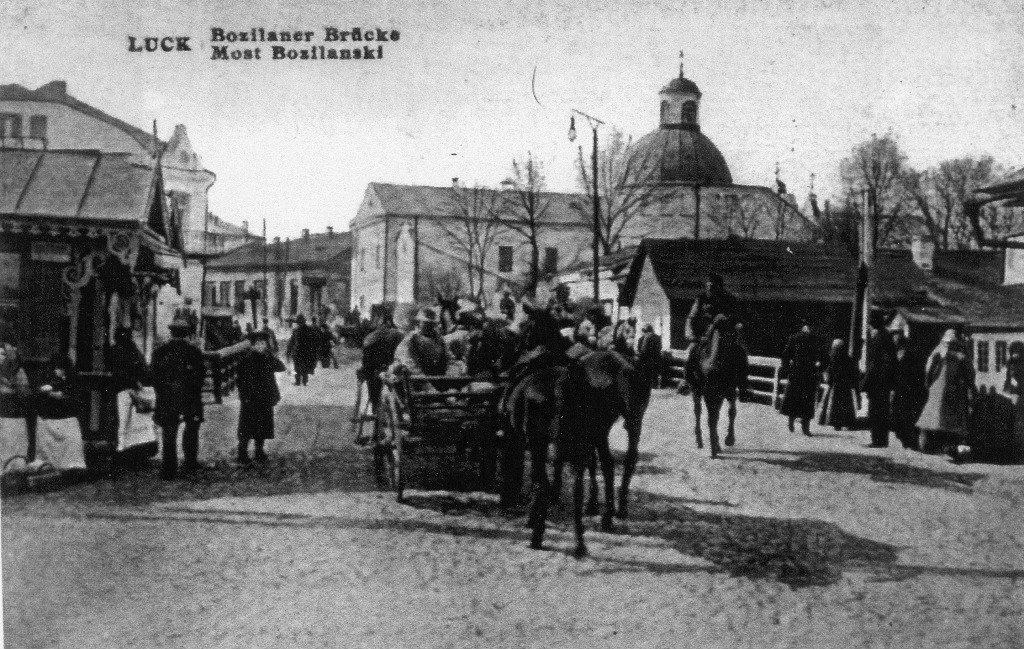
Bratskyi Mist and the church. Postcard of the 1910s. Wikimedia Commons, public domain
Between the wars and the Soviet period
- 1921–1939
The church was an important centre of the UAOC; the rector Pavlo Pashchevskyi was the first in Lutsk to celebrate the liturgy in Ukrainian. [5, 11]
- 1931 and 1935
In 1931 the Polish authorities dissolved the brotherhood (according to the Encyclopedia of Ukraine); in 1935 it received a new statute. [7, 9]
- 1935–1937
The head of the brotherhood, the architect Serhii Tymoshenko, initiated a change in the silhouette of the dome and the west gable. In the 1930s the monument was partly restored to his design, according to the Great Ukrainian Encyclopedia. [1, 5, 11]
- End of the Second World War
The brotherhood ceased its activity, according to the Encyclopedia of Modern Ukraine. [9]
- 1957
A planetarium was installed in the church. In 1964, according to the Great Ukrainian Encyclopedia, a two-storey wing was added to it. [1, 12, 14]
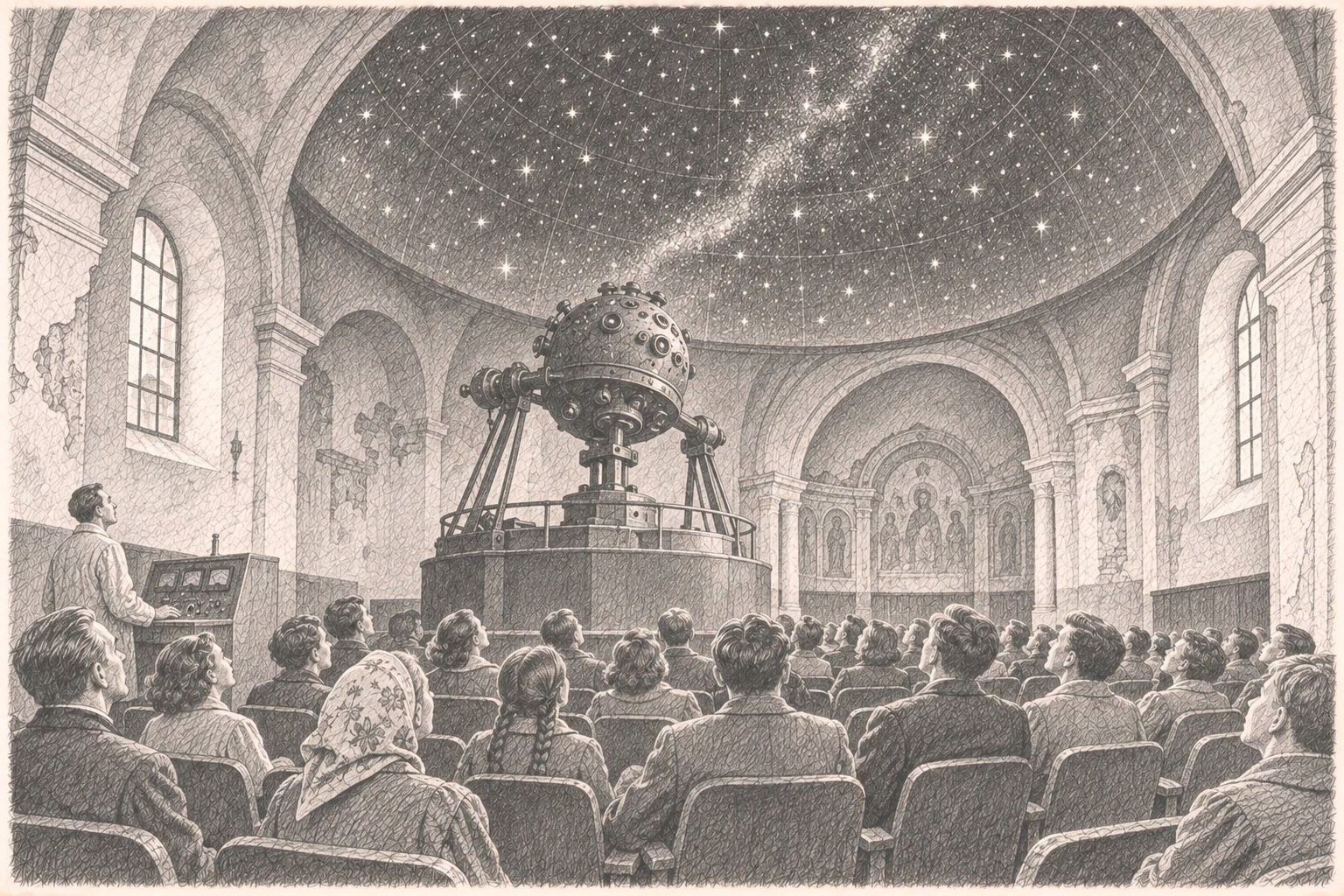
1957: a planetarium in the church (conjectural reconstruction). Illustration: IKONASTONE
Return and memory
- 1990–1992
According to the Great Ukrainian Encyclopedia, in 1990 the city council handed the building to the Volyn Regional Brotherhood of St Andrew the First-Called, and since 1992 it has belonged to the Orthodox Church of Ukraine (at first the UOC Kyiv Patriarchate). [1, 11, 14]
- Late 1990s
The institute Ukrproektrestavratsiia (architect Ye. Osadchyi) drew up a project to recreate the church, which was not carried out, according to the Great Ukrainian Encyclopedia. [1]
- 2000s
Part of the basement necropolis was cleared; the rector Fr Vasyl found a cross among the rubbish, which was later set up on the dome. According to Misto-media. [12]
- 2010
The regional budget allocated about UAH 50,000 for a separate entrance to the crypt; the arched vault was walled up, and fitting it out requires more than UAH 200,000, according to Zaxid.net. That same year, according to the Great Ukrainian Encyclopedia, repairs to the church were completed. [1, 6]
- 27 September 2011
The Museum of the History of the Lutsk Brotherhood of the Exaltation of the Holy Cross was opened in the building of the former monastery (5 Yova Kondzelevycha Street). [12, 19]
- November 2015
The museum opened an exhibition marking the 125th anniversary of the consecration of the restored church, according to Boiarchuk. [5]
- 2020
About twenty people live in the former monastery; the basement is flooded and privatisation of the building is forbidden, according to Suspilne. [18]
- 22 November 2021
The Holy Synod of the OCU gave its blessing for the local veneration of Halshka Hulevychivna (day of commemoration 18 September), according to Suspilne. [15]
Lost and recreated
| What | What it was | What happened | Where it is now |
|---|---|---|---|
| The brotherhood’s main church | Masonry, three-nave, four-pier, three-apse, with Renaissance features and defensive elements; a porch with a tower on the west; three domes [1] | Fires in 1761 and 1803; in 1864 the ruins were sold and dismantled [1, 10] | The sanctuary part with the apse remains; in 1890 a small church was rebuilt on its base [1] |
| Side naves and narthex | Parts of the original church | Dismantled in 1864 [1] | Not recreated; the late-1990s project was not carried out [1] |
| Dome and west gable | The present dome has no drum [1] | In 1935–1937 the silhouette of the dome and gable was changed on the initiative of S. Tymoshenko [5, 11] | Preserved in that form [1, 5] |
| Wooden church and school of 1620 | According to Wikipedia (en), built by the brotherhood [10] | Their later fate is not described in the sources | Not preserved |
| Brotherhood printing house | Operated from 1635 (Telytsia’s equipment) [4, 10] | Printing declined along with the brotherhood [2] | Some editions survive, e.g. the “Lament” of 1628 [2, 4] |
| Monastery with hospital and school | A two-storey masonry building of 1646–1647 [3, 10] | Fires (traces are still visible on the walls); after 1713, the Basilians [1, 12] | Preserved almost in its original form; now a residential building and the brotherhood museum [12, 14, 18] |
| Crypt (necropolis beneath the sanctuary) | Burials of the brethren [1, 6] | Filled with rubbish, flooded by groundwater [6, 12] | Partly cleared in the 2000s; has a separate entrance since 2010; open to visitors [5, 6, 19] |
| Tombstone of H. Posoleikovych (d. 1569) | Burgomaster of Lutsk | Set into the wall of the church [1, 11] | On the north facade [1] |
| 19th-century iconostasis | Oak, carved and gilded, 16 icons (according to Wikipedia (en)) [10] | Its later fate is not described in the sources | In the church [10] |
| Old interior and furnishings | Early printed books, 18th-century votive offerings, a Gospel of 1640, the description of 1806 [5] | Their condition after the fires is unknown | Some documents and objects are on display in the brotherhood museum [5, 19] |
| The Hlushets river | Flowed near the complex | Its mouth was filled in at the end of the 1920s [12] | No longer exists |
| Planetarium in the church | 1957 [1] | Soviet period [12] | The church functions as a place of worship [14, 19] |
Architecture
The original church is known from descriptions, engravings and measured surveys. The Great Ukrainian Encyclopedia describes it as a three-nave, four-pier, three-apse masonry building with Renaissance features and elements of defensive architecture. On the west was a porch with a tower, and the composition was crowned by three domes.
Wikipedia, citing B. Kolosok and R. Metelnytskyi, paints a somewhat different picture. The church was 17 sazhens long and consisted of an apse and four equal square chambers separated by arches. Narrow aisles ran on either side of the two middle chambers, and a sacristy and a treasury flanked the presbytery. Domes with lanterns stood over the presbytery and over the square of the middle nave. So the sources disagree on the number of apses and domes.
Below are two elements of the church in more detail.
Three-chamber and three-nave at once
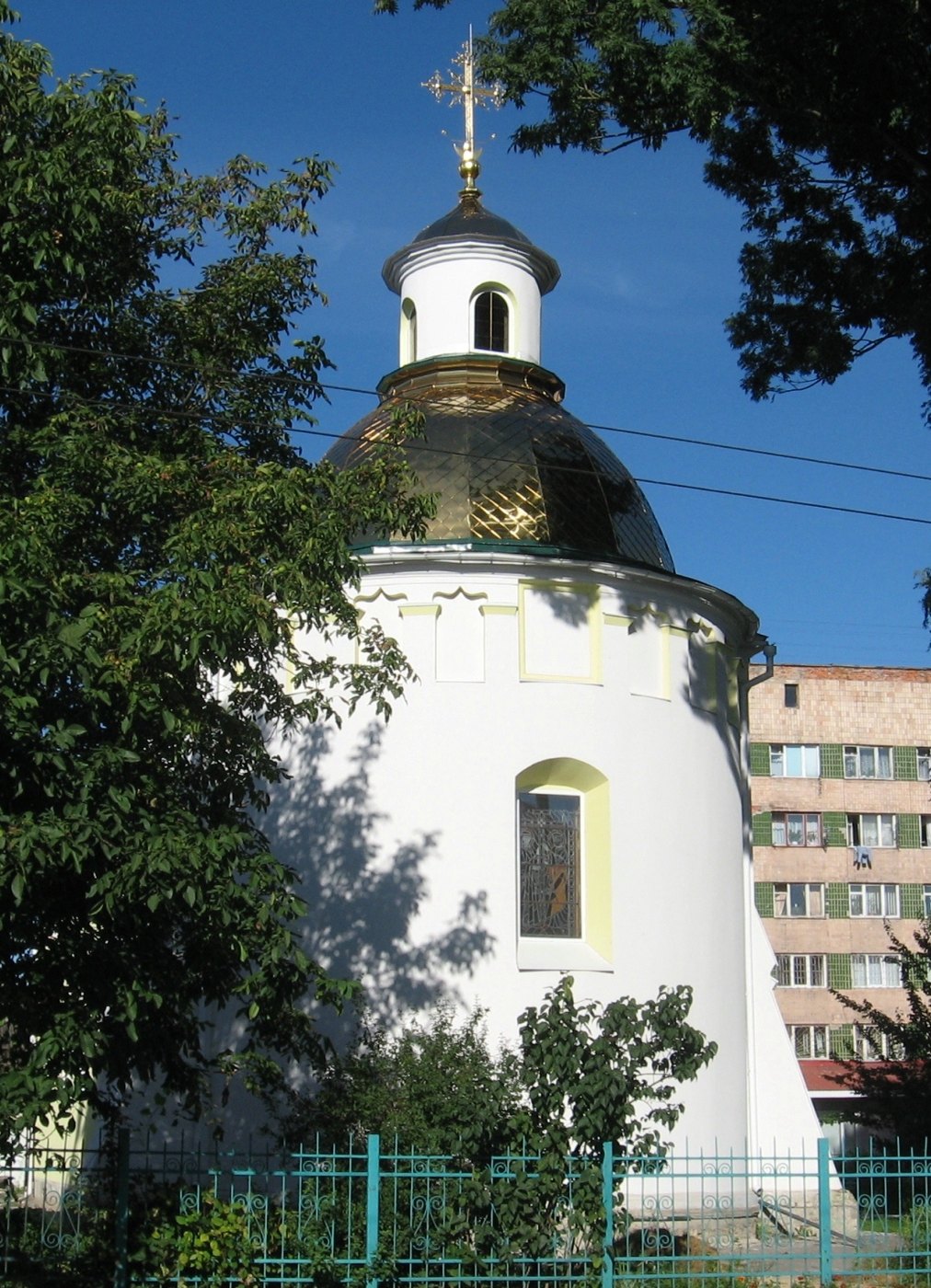
The most interesting thing about this church is the combination of two logics. Wikipedia puts it this way: the church embodied both the three-chamber scheme typical of Ukrainian wooden churches and the three-nave scheme that comes from Byzantine architecture. The Great Ukrainian Encyclopedia also stresses the influence of wooden architecture on masonry. Chambers following one another along an axis are the way a carpenter thinks. Arches, piers and side aisles are the language of a mason. Here they were put together in one building.
Buttresses on either side of the apse
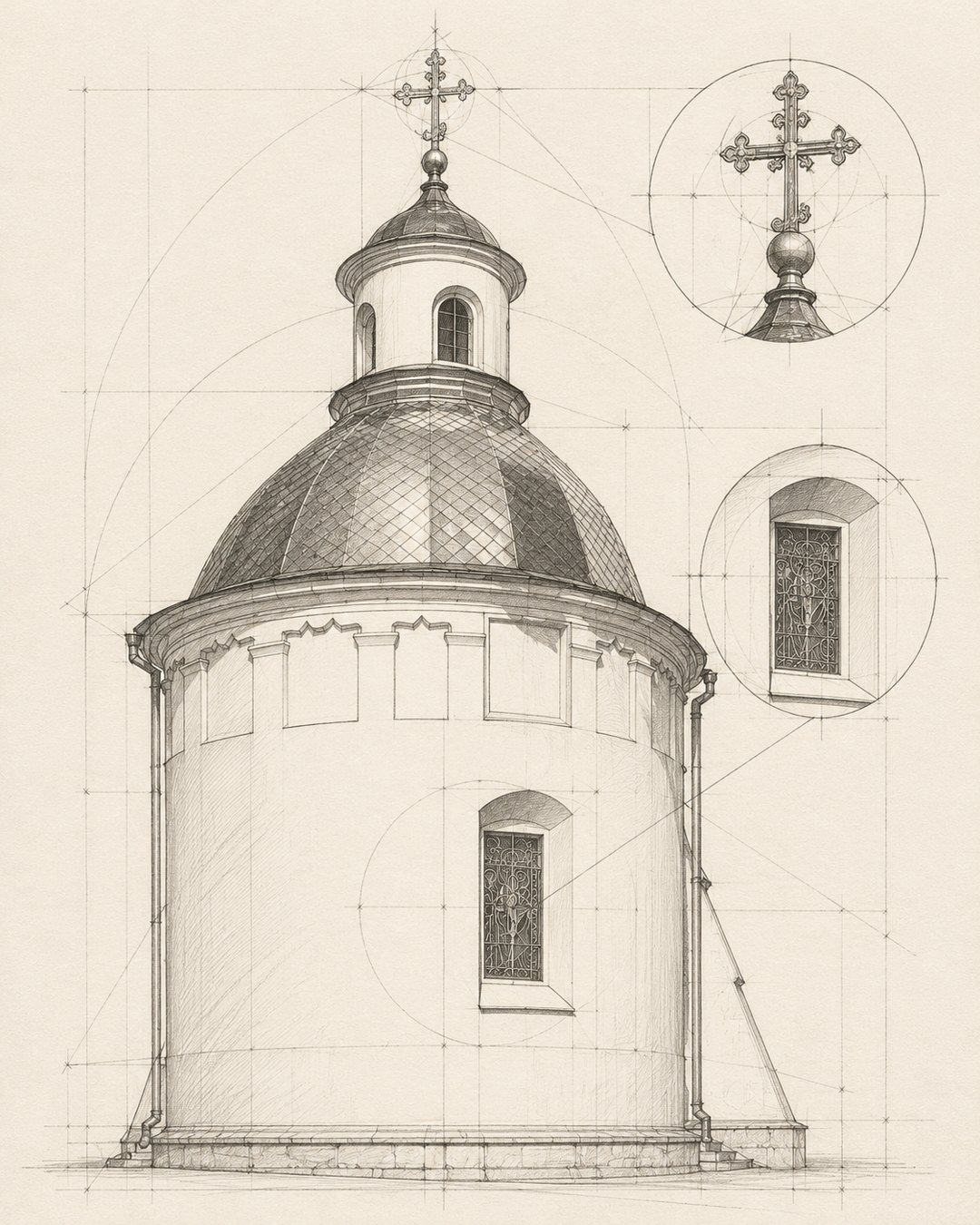
According to Wikipedia, the nave and the narthex were supported by buttresses, and they can still be seen on either side of the sanctuary part. The Great Ukrainian Encyclopedia describes the present building as a single-domed masonry structure, rectangular in plan, with a semicircular apse on the east, two buttresses and a two-storey annex on the west. A buttress is a support that takes the thrust of the vaults. When there are no longer vaults over the nave, it goes on standing as a witness: it shows where the wall ended and what weight it carried.
The dome and the axis
The present central part, according to the Great Ukrainian Encyclopedia, is crowned by a dome without a drum. Wikipedia considers it similar to those that once stood over the presbytery and the middle nave. The tall dome gave Danyla Halytskoho Street its vertical. At the opposite end of the street a choral synagogue was built at the same time, sharing elements of exterior decoration with the brotherhood church. Together they form the north–south compositional axis of the historic centre.
Stone and material
The church is built of brick. The stone in it is above all memorial. According to the Great Ukrainian Encyclopedia, the tombstone of the Lutsk burgomaster Hryhorii Posoleikovych (died 1569) and a memorial plaque to Halshka Hulevychivna are set into the north facade. Posoleikovych’s slab, according to Wikipedia, was moved here from the cemetery of St Lazarus Church while the church was being built. A stone slab in a masonry wall is an old way of keeping memory: it outlives both the cemetery and the church it was taken from.
Beneath the church there is a crypt where members of the brotherhood are buried, among them Danylo Bratkovskyi. Next to the church is a memorial plaque with the names of those buried.
What to see
- The apse with buttresses — the oldest part remaining from the 17th-century church.
- The north facade with Posoleikovych’s tombstone and the plaque to Hulevychivna.
- The dome that sets the vertical of the street.
- The former brotherhood monastery at 5 Yova Kondzelevycha Street. According to Wikipedia, unlike the church, it has survived almost in its original form, with minor repairs after fires; inside are vaulted rooms.
- The 19th-century iconostasis of oak, carved and gilded, for 16 icons (according to Wikipedia); for a time it was kept in the Holy Trinity Cathedral.
In the brotherhood church the sanctuary part outlived everything else — and it was from it that the church was reborn. We have written about what stands inside the sanctuary in the article on altar tables.
Did you know
The privilege of stauropegion, which took the brotherhood out from under the authority of the local Uniate hierarchs, was, according to Andrii Boiarchuk, the only one of its kind in the city. [5]
The first royal charter is dated either 20 February 1619 (RISU) or 2 February (Shtanko). [2, 4]
Noblemen in the brotherhood were called “senior brethren”, townspeople “junior brethren”. [2, 3, 4]
According to O. Shtanko, 55 noble families belonged to the brotherhood; the largest was the Hulevych family (9 people). [4]
Under the statute of 1624, prospective pupils were tested for three days before being admitted to the school. [4]
The “Lament” on the death of the presbyter Ioan Vasylevych was published by the brotherhood printing house; the collection is classed as Baroque poetry. [2, 4]
Oleksandr Mozelli, a physician, left the brotherhood more than 70–72 thousand zlotys (according to Wikipedia (en), 40 thousand zlotys for a masonry hospital). [4, 10, 12]
On 27 August 1890 Alexander III arrived for the litia after the consecration of the church; Petro Kosach, the father of Lesya Ukrainka, was to come out to meet him. [5, 9]
In the interwar period the liturgy was celebrated in Ukrainian in this church for the first time in Lutsk. [5, 11]
The collection of manuscripts and early printed books at the revived brotherhood became, according to the Encyclopedia of Modern Ukraine, the first public museum in Lutsk. The present brotherhood museum, according to Misto-media, is the only museum in Ukraine devoted to a brotherhood organisation. [9, 12]
According to the rector, when the necropolis was being cleared a cross was found among the rubbish, which was later set up on the dome. [12]
The present church, according to Misto-media, is only the sanctuary part of the former church, which was about 25 m long. [12]
Black traces of fires are still visible on the walls of the masonry monastery. [12]
Donors included not only the nobility but also townspeople: the burgomaster Samiilo Soltan, Anastasiia Zubtsevska and Yurii Bozhkevych. They gave land, valuable furnishings, debts and books. [4]
Legends
A cross from under the rubbish
According to the account of the rector Fr Vasyl, recorded by Misto-media, a cross was found while the rubbish was being cleared, and was later placed on the dome. [12]
Who rests in the crypt
According to Petro Tronevych of the Volyn Regional State Administration, eminent brethren are buried in the church basement — Danylo Bratkovskyi, Halshka Hulevychivna, Lavrentii Drevynskyi and others. The sources do not name the exact burial place. [6]
The “political centre” of Volyn's Orthodox
By the traditional definition, in the 1630s–1640s the complex was the “political centre of the Orthodox people of Volyn”; this is an assessment, not a document. [10]
Figures
- Hryhorii (Herasym) Mykulych — hegumen of the Chernchytsi Monastery, hieromonk; will of 23 August 1617.
- Sigismund III Vasa — the king who issued the brotherhood a charter in 1619.
- Theophanes III — Patriarch of Jerusalem, who permitted the building of the church with stauropegion (1620).
- Cyril Lucaris — Patriarch of Constantinople, who confirmed the stauropegion and the statute (1623).
- Yurii Puzyna — a prince, the brotherhood’s chief patron until his death in December 1648.
- Halshka Hulevychivna — a Volyn patron of the arts (c. 1577–1642), donor to the brotherhood and founder of the Kyiv Epiphany Brotherhood; locally venerated by the OCU since 2021.
- Samiilo Soltan — burgomaster of Lutsk and a brother of the brotherhood, a donor.
- Pavlo Domzhyv Liutkevych Telytsia — printer of the “Lament” (1628), who gave the printing house to the brotherhood in 1635.
- Oleksandr Mozelli — a physician who bequeathed the brotherhood more than 70 thousand zlotys; hospital privilege of 1645.
- Yov Kondzelevych (1667 – c. 1740) — an icon painter born in Zhovkva, who taught at the brotherhood school and died in Lutsk. [20, 23]
- Danylo Bratkovskyi — a poet and noble brother of the brotherhood, executed in Lutsk in 1702.
- Ivan Vyhovskyi — the future hetman, among the known figures of the brotherhood.
- Hryhorii Kornakovskyi — the abbot, author of the description of the church in 1806.
- Petro Kosach — marshal of the nobility, an active brother of the revived brotherhood.
- Oleksandr Levytskyi — a historian, author of the work “Lutskaia starina” (Kyiv, 1891).
- Serhii Tymoshenko — an architect, head of the brotherhood; changed the silhouette of the dome in 1935–1937.
- Pavlo Pashchevskyi — the rector, the first in Lutsk to celebrate the liturgy in Ukrainian.
- Andrii Bondarchuk — a patron and initiator of the brotherhood museum; according to Zaxid.net, funds for the crypt entrance were sought at his request.
How to cite
IKONASTONE. The Holy Cross Exaltation Church in Lutsk (brotherhood church) // Guide to the Churches of Ukraine. URL: https://ikonastone.com/en/guide/holy-cross-exaltation-church-lutsk/ (accessed DD.MM.YYYY).
FAQ
Where is the Holy Cross Exaltation Church?
In Old Lutsk, at 2 Danyla Halytskoho Street, where Rynok Square meets Bratskyi Mist. The former brotherhood monastery stands next to it, at 5 Yova Kondzelevycha Street.
When was the church built?
The Lutsk Brotherhood received a royal privilege in 1619; the Encyclopedia of Ukraine dates the first brotherhood church to 1619–1620. The main masonry church, according to the Great Ukrainian Encyclopedia, was built in 1619–1634 (according to other data, restored). After it was dismantled in 1864, a small church was rebuilt from the sanctuary part in 1888–1890.
What survives of the 17th-century church?
The sanctuary part with its 17th-century apse decorated with an arcaded frieze, and the buttresses on either side of it. The sources disagree about the dome: Wikipedia considers it old, while the Great Ukrainian Encyclopedia describes the present top as a dome without a drum. The side walls and the narthex were dismantled in 1864. Members of the brotherhood are buried in the crypt.
What is the monument's status?
An architectural monument of national importance, protection No. 79.
Sources
- ВУЕ. Хрестовоздвиженська церква в Луцьку
- РІСУ. П. Кралюк. Луцьке Хрестовоздвиженське братство: генеза і функціонування
- Волинські новини. О. Штанько. Кілька штрихів до історії Хрестовоздвиженської церкви у Луцьку (2026)
- Волинські новини. О. Штанько. Луцьке Хрестовоздвиженське братство: штрихи до історії (2017)
- А. Боярчук. Братська Хрестовоздвиженська церква — особлива культова споруда старого Луцька (17.11.2015). Волинський краєзнавчий музей
- Zaxid.net. У Луцьку хочуть облаштувати крипту під туристичний об'єкт (01.12.2010)
- Encyclopedia of Ukraine. Lutsk Brotherhood of the Elevation of the Cross
- Encyclopedia of Ukraine. Lutsk
- Енциклопедія сучасної України. Луцьке хрестовоздвиженське братство
- Wikipedia (en). Lutsk Orthodox Fellowship of the True Cross
- Наша Парафія. Хрестовоздвиженська (Чеснохресна) церква, Луцьк
- Місто-медіа. Які таємниці зберігає музей історії луцьких братчиків
- О. Альошина. Організаційні засади та набутки культурно-освітньої діяльності… «Наукові записки НаУОА», сер. «Релігієзнавство», 2017, № 2 (14)
- Via Regia Ukraine. Church of the Exaltation of the Cross
- Суспільне. Волинську меценатку Галшку Гулевичівну визнали святою
- Радіо Свобода. Данило Братковський (29.11.2001)
- Encyclopedia of Ukraine. Bratkovsky, Danylo
- Суспільне. У Луцьку колишній монастир василіан, де живуть люди, підтоплює (20.04.2020)
- Travels in Ukraine. Lutsk Brotherhood History Museum
- Encyclopedia of Ukraine. Lutsk Brotherhood of the Elevation of the Cross School
- Wikimedia Commons. File:Map of Lutsk 1860.jpg (через дзеркало)
- Wikimedia Commons. File:Tadeusz Jerzy Stecki - Łuck starożytny i dzisiejszy… (1876)
- Encyclopedia of Ukraine. Kondzelevych, Yov
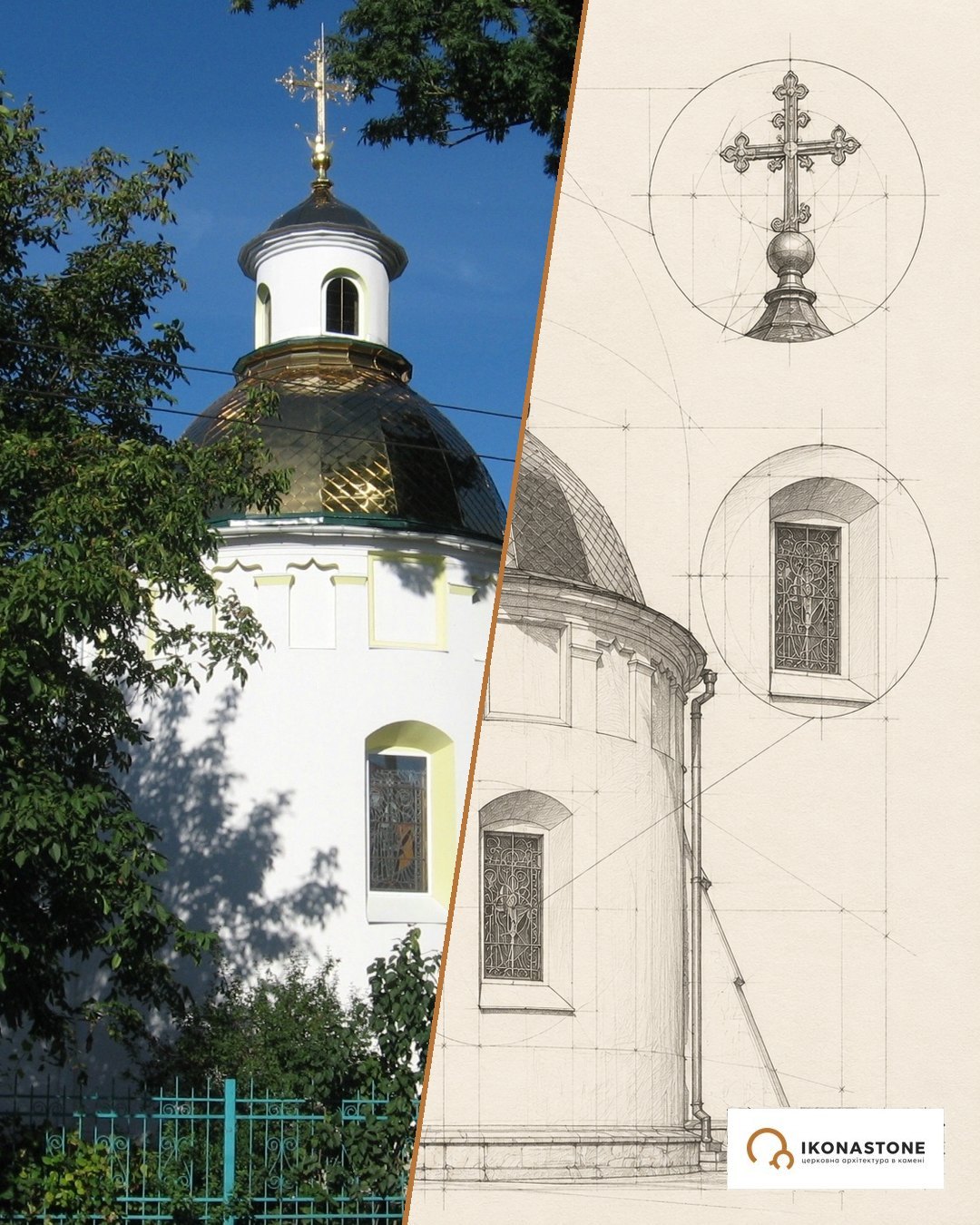
- Town
- Lutsk, Volyn Oblast
- Built
- 1619–1634 (according to the Great Ukrainian Encyclopedia; according to other data, the church was not built but restored at that time); rebuilt 1888–1890
- Type
- masonry church; now single-domed, with an old apse and buttresses
- Material
- brick
- Research depth
- 36%