The Saviour Not-Made-by-Hands: a round icon on stone
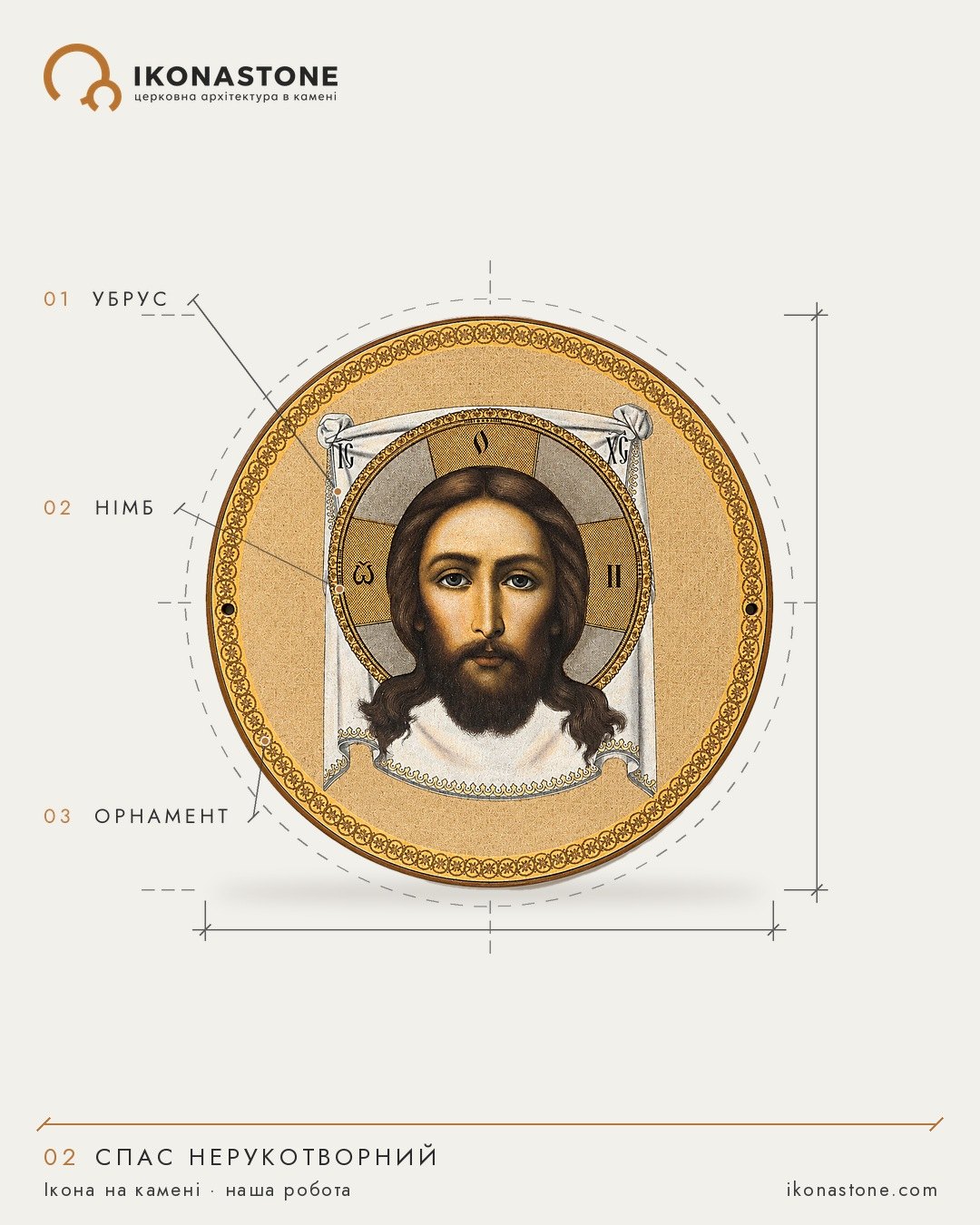
There is an image that, according to Tradition, no human hand made. The Saviour Not-Made-by-Hands is the face of Christ imprinted on cloth. Here it is in a round form: an icon on stone with an ornament running round the circle.
What “Not-Made-by-Hands” means
Tradition tells of Abgar, the ruler of Edessa. He was ill and sent word to Christ. Christ washed His face and wiped it with a cloth, and His face was imprinted on the cloth. The cloth is called an убрус (ubrus); in Greek, a mandylion. Hence the name of the image: not made by hands.
By Tradition, this is the first image of Christ. The feast in its honour, the Translation of the Image Not-Made-by-Hands from Edessa to Constantinople (944), falls on 16 August by the Revised Julian calendar (in communities that keep the Julian calendar, on 29 August by the new style). In popular tradition this day is called the Third Saviour.
How to recognise the icon of the Saviour Not-Made-by-Hands
The icon shows only the face of Christ: no neck or shoulders, usually against the cloth, often with knots in the upper corners. Around the face is a cruciform halo with the Greek letters ὁ ὤν, meaning “He Who Is”. On either side are the letters IC XC, the abbreviation of the name Jesus Christ.
Why a round form suits the Saviour Not-Made-by-Hands
A circle has no corners for the eye to wander off to. Attention keeps returning to the centre, to the eyes. For an image that consists of a face alone, this is the most natural frame.
A round icon on stone: what makes it difficult
For stone, a circle is a more demanding form than a rectangle. Along the edge, inaccuracies cannot be hidden: any deviation of the line shows at once. So the edge and the ornament round the circle need the same attention as the face itself.
Where the Saviour Not-Made-by-Hands is placed
According to the same Tradition, in Edessa the image was set in a niche above the city gate. Hence the old custom of placing the Saviour Not-Made-by-Hands above gates and entrances: city gates, the entrance to a church.
A round image sits well in a niche, above a door or in the centre of a gable. For a façade, the size is decided not by the sheet of sketch paper but by the height of placement and the distance from which the icon will be viewed.
Questions and answers
What size can a round icon on stone be? We choose the diameter to suit the place: a niche, the wall space above an entrance, or a gable. We begin with a photograph and measurements.
Is an icon on stone suitable for a façade? Yes, but outdoors it matters how the stone withstands frost and water, and whether the image is protected by a niche or an overhang. We settle this at the drawing stage.
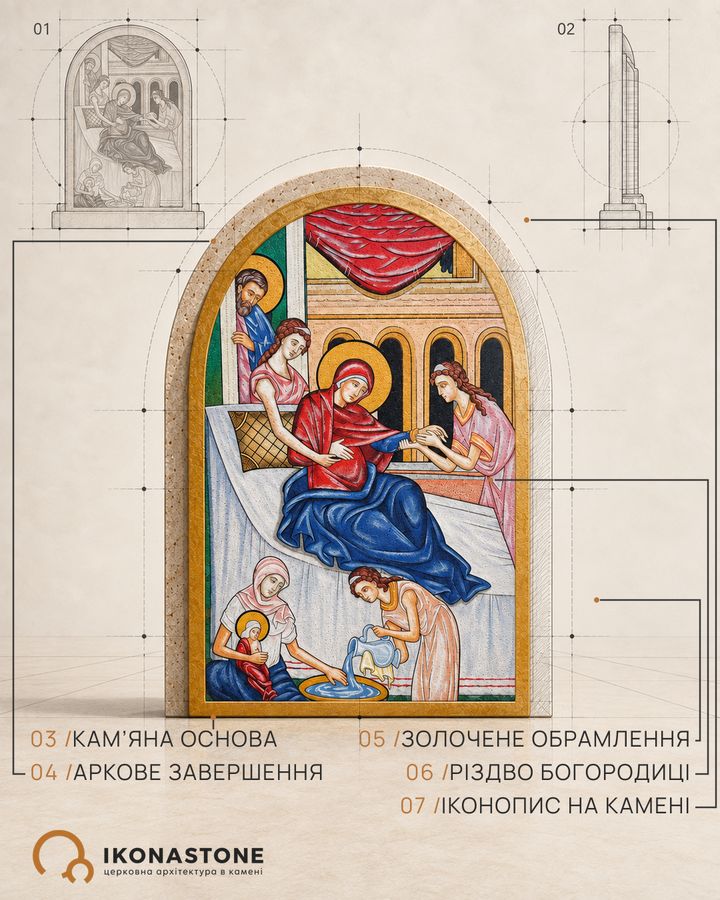
Can this image be made in another form? Yes. The Saviour Not-Made-by-Hands appears both in a rectangle and in an arch. The place suggests the form.
If you have a niche, a gable or a place above an entrance, send us a photograph and measurements and we will suggest a diameter: +380 66 892 98 18. More about this line of work is on the Icons on stone page.