Icon of St Nicholas on stone: arch, halo and inscription
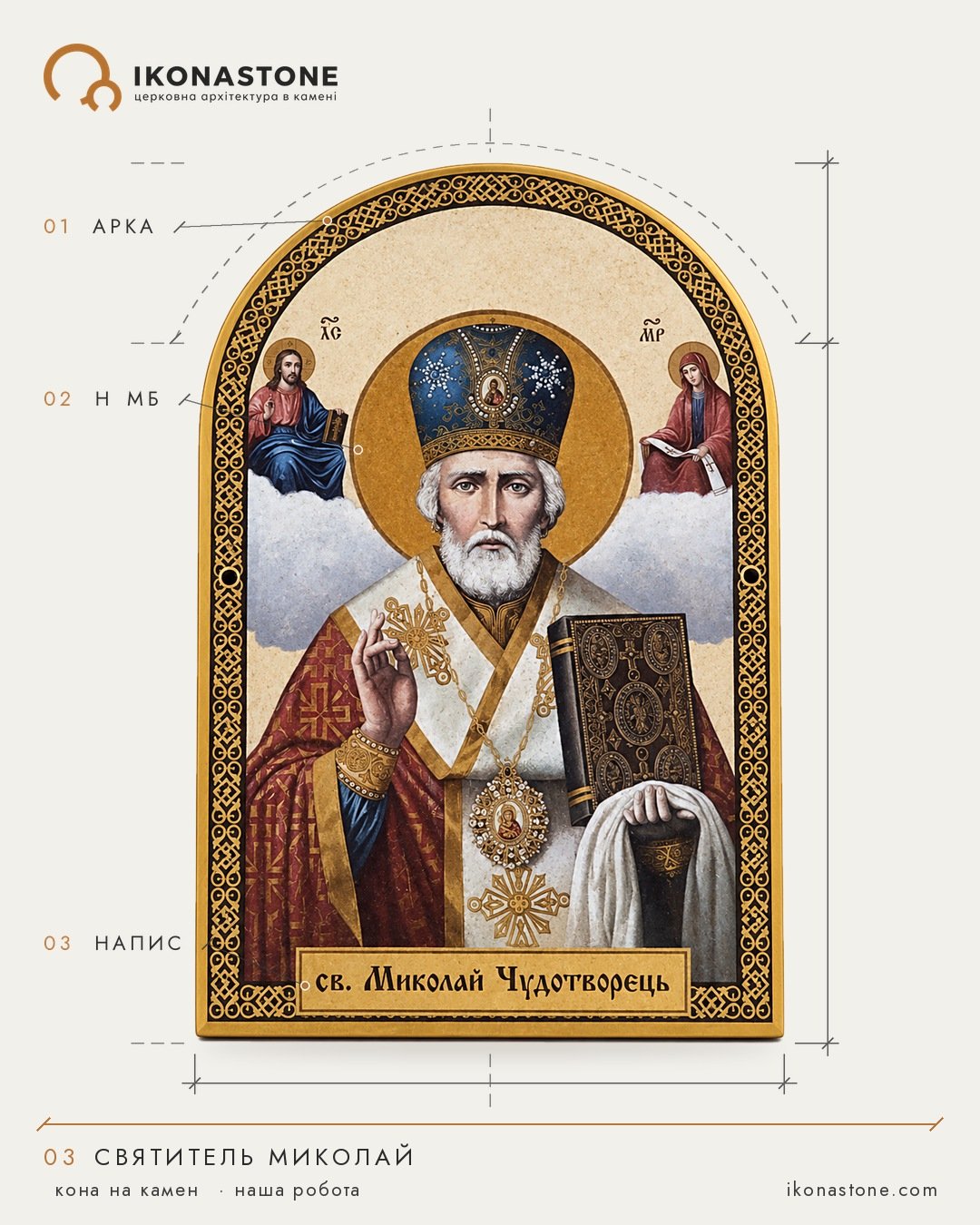
Arch, halo, inscription: only three details are labelled on the image, and each one stands for a separate decision. This is an icon of St Nicholas on stone: the saint in episcopal vestments and a mitre blesses with his right hand and holds a closed Gospel in his left.
Icon of St Nicholas on stone: how to recognise the image
Nicholas was bishop of Myra in Lycia, in Asia Minor, in the 4th century. The icon of St Nicholas the Wonderworker shows him precisely as a bishop: in liturgical vestments, with the Gospel in his left hand and his right hand raised in blessing. On icons the saint’s head is sometimes bare and sometimes mitred. Here he wears the mitre.
He does not hold the book with a bare hand but through a cloth. This is how an icon expresses reverence for the Gospel: the hand that holds the book is covered by the fabric of the vestments.
Christ and the Mother of God above: the Gospel and the omophorion
In the upper corners of the icon, on clouds, are two small figures: Christ on the left and the Mother of God on the right. This is not decoration but a narrative.
A late hagiographical account relates that at the First Council of Nicaea in 325 Nicholas struck Arius, whose teaching the council condemned. According to this account, the saint was stripped of his episcopal insignia and imprisoned, and at night Christ and the Mother of God appeared to him: Christ gave him the Gospel, and the Mother of God gave him the omophorion, the broad band worn on the shoulders, the mark of a bishop.
The small figures on either side of the saint’s head are linked with this account: Christ with the book and the Mother of God with the omophorion.
The feast of St Nicholas is on 6 December by the Revised Julian calendar; in communities that keep the Julian calendar it falls on 19 December by the new style.
An icon on stone in an arch: why this shape
An arch is a curved vault that spans an opening in a wall. A window, a portal, a niche: a building knows this outline even without an icon. So an image in an arch does not lie on the wall; it enters into it.
The rounded top leaves room for the halo and the small figures on the clouds. The eye rises without corners to stumble on. And the radius of the arch is taken from the place, not from the sheet of sketch paper.
The halo and the gold ground behind the head
A halo is a circle of radiance around the head, a sign of holiness. On this icon the ground behind the saint’s head is gold; in iconography gold signifies heavenly light.
For stone this is a question of the boundary. Where does the halo end and the ground begin, and what separates them: a line or a tone? The answer decides whether the face can be read from a distance.
The inscription on the icon: the name as part of the image
At the bottom is a band with the inscription “St Nicholas the Wonderworker”. An icon is inscribed: the name on it says whom it shows. Without an inscription one saint is easily mistaken for another, since the vestments of bishops are alike.
In stone the inscription also has a size. The letters are chosen for the distance from which the icon will be viewed. The ornament along the edge holds everything together: the arch, the figure, the band with the name.
What to decide before ordering
- The arch. Its height and radius are set by the place: a niche, a wall pier, the space above an entrance.
- The halo. A gold ground or only an outline, and how it will read from a distance.
- The inscription. The form of the name, the language, the size of the letters.
- The small figures. Christ and the Mother of God above need space: on a small icon they will be cramped.
Questions and answers
Is this image suitable as an icon for a church of St Nicholas? Yes. The image of the saint is appropriate in a church of his name, in a chapel and in a façade niche. The size and outline of the arch are suggested by the place.
Are Christ and the Mother of God in the upper corners obligatory? No. The saint is also painted without them; these figures are added when the image is meant to recall the account of the Gospel and the omophorion.
Where to begin? With a photograph and the dimensions of the place. Then the sketch and drawing, approval, fabrication and installation.
If you are planning an image of the saint for a church or chapel, send a photograph of the place and its dimensions, and we will suggest the outline of the arch and the size of the inscription: +380 66 892 98 18. More about this line of work is on the Icons on stone page.