Memorial Plaque: How to Install One and Get Permission
A memorial plaque takes up less space on a facade than a window. Yet more is asked of it than of a window: it has to outlast renovations, changes of owners and several generations of passers-by. And it must do so without quarreling with the building it hangs on.
That is why a plaque is not simply ordered and screwed to the wall. It is agreed: with the community, with the building’s owner, sometimes with the heritage authorities. People who face this for the first time are most alarmed by exactly this part, though its logic is simple.
This article is for families, schools, companies and public organizations who want to commemorate a person or an event. Today many such plaques honor fallen defenders, but the procedure is broadly the same for a teacher, a doctor, a writer or a notable date. The rules in your community may differ, so check everything below against the local regulation.
In brief
- Permission for a memorial plaque is given by a local self-government body, usually the council’s executive committee (or the military administration where one is in charge), after review by a dedicated commission.
- We found no single nationwide procedure for all memorial plaques; each community adopts its own regulation.
- A typical package: an application, a note about the person or event, the inscription text, a sketch with size and material, the building owner’s consent, and a commitment to cover the costs.
- If the building is an architectural heritage site or stands in a protection zone, the heritage protection authority must also approve.
- The material should be durable: granite, marble, bronze, cast iron; the size should be proportionate to the facade.
Who decides on a memorial plaque?
The short answer: the community, that is, the local self-government body. In practice it looks like this. The application goes to the council’s executive body. A commission reviews it; in different cities it has different names: a commission on names and memorial markers, an advisory council, and so on.
The commission may support the application, suggest another way of commemoration, or refuse. Another way means, for example, not a plaque on the facade but a sculptural portrait, a bust or a themed display inside the building. This option is written into the draft national procedure for plaques honoring defenders, discussed below.
The final decision is made by the council’s executive committee. For example, in October 2023 the executive committee of the Poltava city council voted to approve plaques for three fallen soldiers on the facades of two schools and a gymnasium. In communities under military administration, the decision is issued as an order of its head; this is what the 2023 regulation of the Sloviansk city military administration says, among others.
One important nuance: in many regulations, applications are not accepted from just anyone. The list is usually: enterprises, institutions, organizations, public associations, creative unions, work collectives, and also close relatives of the person being commemorated. In Sloviansk, applications from other private individuals are not considered. In Kirovohrad in 2015 they were considered only together with the support of some organization. So a family or friends may find it easier to apply together with a school, a company or a public organization.
Are there nationwide rules?
We found no law or government resolution that sets a single procedure for all memorial plaques in Ukraine. Communities adopt their own regulations on the basis of the Law of Ukraine “On Local Self-Government in Ukraine” (“Про місцеве самоврядування в Україні”). If a heritage site is involved, the Law “On the Protection of Cultural Heritage” (“Про охорону культурної спадщини”) applies as well.
In 2021 the Ministry of Veterans Affairs prepared a draft resolution of the Cabinet of Ministers with a separate procedure for plaques and memorial markers honoring defenders. We found no adopted resolution with such a procedure, so this is a draft, not a rule in force. We mention it only as a guide: many of its requirements are repeated in community regulations.
The practical conclusion: the first step is to find the current regulation on memorial markers and plaques on your council’s website, or to call the culture department. Everything else depends on it.
Which documents are needed for permission?
The list varies, but in the regulations of Kryvyi Rih, Sloviansk and Kropyvnytskyi (then still called Kirovohrad), and in the draft national procedure, roughly the same items repeat:
- an application from the initiator (for an organization, with a decision of its governing body);
- a historical or biographical note with references to sources, and copies of archival or award documents;
- a document showing the person’s link to the building: lived here, studied here, worked here;
- the text of the inscription;
- a sketch design: an image of the plaque, size, material, typeface, and position on the facade;
- the consent of the owner or the balance holder of the building, if it is not municipal (the balance holder is the organization that has the building on its books and is responsible for maintaining it);
- a written commitment to cover the costs of making and installing the plaque;
- the consent of one of the relatives of the person being commemorated (where this is provided for);
- the approval of the heritage protection authority, if the building is a heritage site.
Some regulations add a waiting period: a plaque is installed no sooner than a certain time after the death or the event. In Kirovohrad in 2015 this was, as a rule, five years, with an exception for Heroes of Ukraine and honorary citizens of the city. In Sloviansk in 2023 it was, as a rule, one year. Another typical rule: one person, one plaque within the community.
What should the text and image be like?
The Kryvyi Rih procedure puts the requirement briefly: in Ukrainian, concise, without abbreviations. The Sloviansk regulation adds that the full name (surname, first name and patronymic) and the dates are mandatory. Then, briefly, how the person is connected with this building and in which years.
Text on stone is read standing, in passing, often from below. So every extra word costs more here than on paper. A good inscription usually contains: the name, the dates of life, one sentence about the person, and the link to the place. Rank, awards and unit are included at the family’s wish and according to the community’s rules.
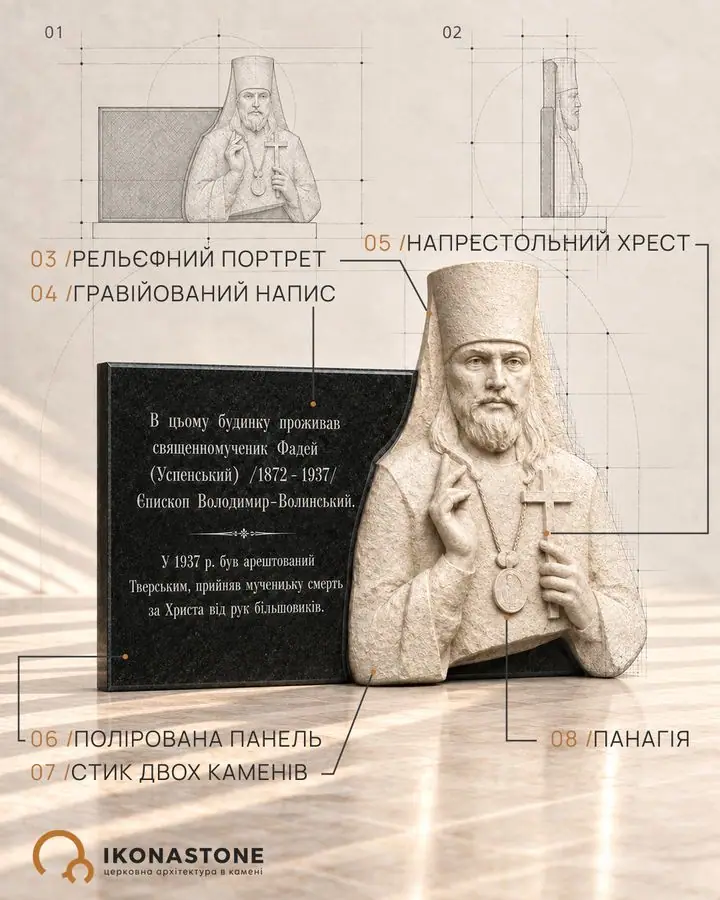
An image, whether a portrait, a bas-relief or a symbol, is permitted, but it too is shown in the sketch. A portrait is engraved on granite or made as a relief in bronze or stone; we write about relief sculpture in the sculpture section. Local requirements for symbolism are better clarified before the sketch, not after.
Granite or bronze: what are memorial plaques made of?
The regulations ask for one thing: a durable material. Sloviansk names natural stone (marble, granite) and metal alloys (bronze, cast iron, aluminum) outright; Kryvyi Rih says natural stone or metal.
Granite. The most common choice. Dark polished granite holds engraved text and a portrait well and does not fear frost or sun. There is one limitation, weight: even a small thick stone slab weighs tens of kilograms, and the fixings for it are calculated separately.
Marble. Light, warm in tone, classic for old facades. But marble is sensitive to acids, even to slightly acidic rain. So outdoors it loses its polish over the years and needs more frequent care than granite.
Bronze. The material for relief, three-dimensional letters, portraits. Bronze darkens and acquires a patina (a thin film of oxides on the surface); for some people this is dignity, for others a flaw, and it is worth knowing about in advance.
| Material | Strengths | What to consider |
|---|---|---|
| Granite | Weather resistance, crisp text and portrait | Weight, fixing |
| Marble | Light tone, classic look | Sensitive to acid rain, loses polish outdoors |
| Bronze | Relief, three-dimensional letters | Patina, casting from a model |
Why stone on a facade lasts for decades and what happens to it in the rain, we described in more detail in the article Icon on Stone or on Wood.
How big should the plaque be?
We found no single nationwide figure. The Kryvyi Rih procedure puts it this way: the size depends on the amount of text, on whether there is a portrait and decoration, and should be proportionate to the building. The 2021 draft national procedure for plaques honoring defenders proposed a limit of no more than 50 × 100 cm. To repeat: this draft did not come into force, so the figure is not binding.
In practice the plaque should be readable from the pavement and should not cover architectural elements: cornices, window surrounds, string courses. Size, typeface and mounting height are best checked on the facade before production, at least with a full-size cardboard mockup. It is simple, and fixing a mistake later is far more expensive.
Very small forms also exist. In 2026 the Kropyvnytskyi executive committee prepared a decision on memory plaques of 21 × 11 cm made of stainless steel, for the backs of benches in squares and parks, in honor of the fallen, prisoners of war and the missing. This is no longer a plaque on a facade but a different genre of remembrance, yet it shows that a community can choose the scale rather than merely approve someone else’s.
What must be agreed with the building owner and with heritage protection?
The building owner. If the building is not municipal, the written consent of the owner or the balance holder is needed. An apartment building is harder: its common property belongs to all co-owners together, and questions about its use are decided by a general meeting (in a homeowners’ association, ОСББ, under the law and the association’s charter). How exactly to formalize consent in a particular building should be checked with the association or the building manager.
An architectural heritage site. If the building is entered in the State Register of Immovable Monuments or stands in a protection zone, local regulations require separate approval from the heritage protection authority. The Law “On the Protection of Cultural Heritage” (Article 26) allows repair, restoration and adaptation of monuments only with the written permission of such an authority. Whether installing a plaque counts as such work is for the authority itself to decide, so it is better to ask for its letter among the first steps: this is where it is easiest to lose time.
How is a plaque mounted on a facade?
What follows is our workshop practice, not a rule of law.
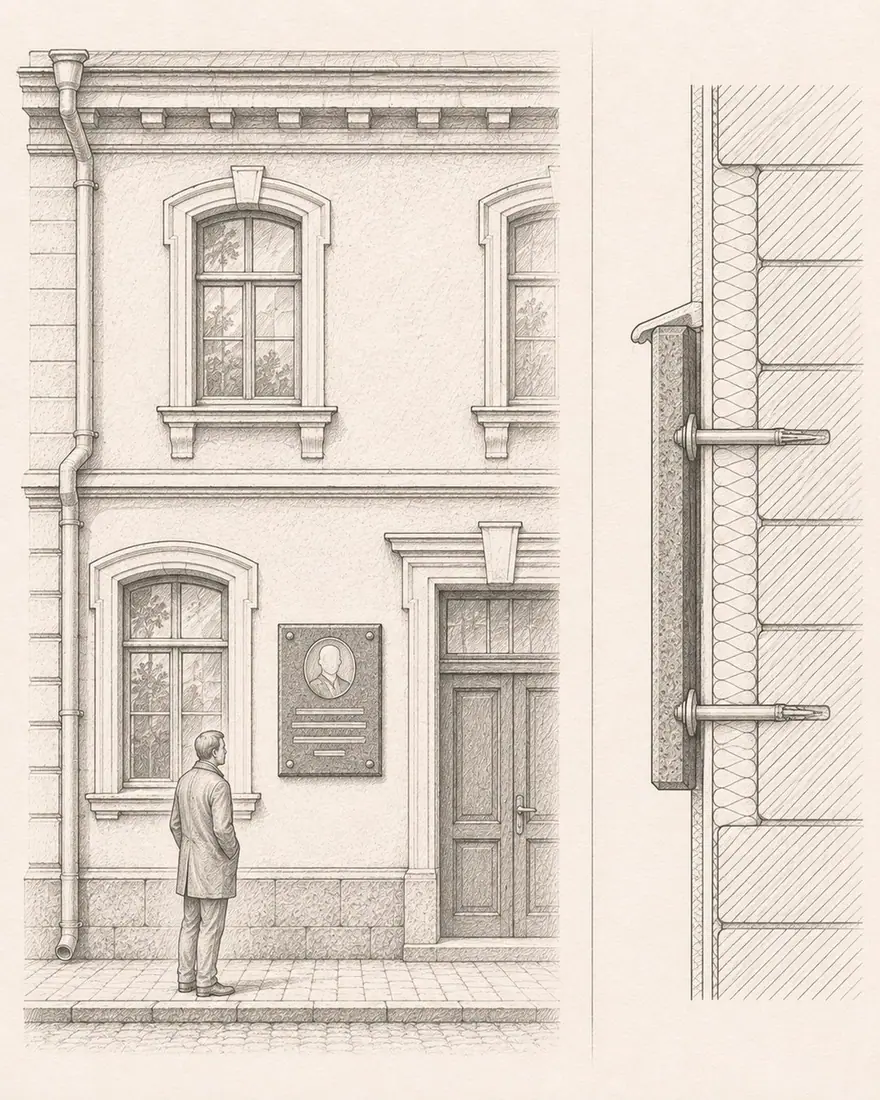
Mounting is the least visible and the most important part. The plaque is fixed to the load-bearing wall, not to the insulation or cladding: on a facade with polystyrene and plaster an ordinary dowel holds poorly. A stone slab is set on anchors or studs calculated for its weight, often with concealed fixing so that the heads are not visible.
A few more things to decide in advance: the height (so that the inscription can be read and the plaque is not easily damaged), the distance from the drainpipe so that water does not run straight onto the stone, and the absence of obstacles such as air conditioners, signs and cables.
After installation the plaque is usually transferred to the books of the building’s owner or to the municipal property of the community. Who maintains it is also written into the regulation. In Sloviansk, for example, the balance holder looks after the plaque at its own expense and, during facade repairs, removes it, stores it and puts it back. For plaques put up without permission an inspection report is drawn up there, and the owners may be required to dismantle them.
The unveiling also has its own procedure. The 2015 Kirovohrad regulation, for example, provided for timing it to a memorial date and holding it as a ceremony with the community present. For a family this is often more important than all the approvals: the day when the name is first read aloud.
What to decide before ordering
- The community’s regulation. Find the current one, and find out who can submit an application and to whom.
- The initiator. The family alone, or together with a school, a company or a public organization.
- The building. Whose it is, whether it is a heritage site, whether it is in a protection zone; how to obtain the consent of the owner or co-owners.
- The text. Full name, dates, link to the place; no abbreviations.
- The image. Portrait, relief, symbol, and whether there are local requirements for them.
- Material and size. Granite, marble or bronze; a size proportionate to the facade, checked with a mockup.
- Fixing. What exactly it will be fixed to, how heavy it is, who installs it.
- Unveiling and upkeep. Who will take the plaque onto their books and who will look after it.
A final thought
A memorial plaque is a short phrase that the building will repeat every day. How it is composed, what it is made of and how it is fixed determine whether it will still be read in fifty years.
IKONASTONE makes such plaques of granite and marble, from sketch to installation; you can read about this in the sections on memorial plaques and design and installation.
Not sure what the piece is called? Walk through the church from sanctuary to churchyard →
Would you like to give something to a church? What to give a church →
Want to remember loved ones or a fallen parishioner? Remembrance at a church →
FAQ
Who gives permission for a memorial plaque?
A local self-government body: usually the executive committee of the city, settlement or village council, and in communities under military administration, its head. Before that, a commission or advisory council set up under the local regulation reviews the application.
Can a private person apply?
It depends on the community’s regulation. Many regulations accept applications from enterprises, institutions, public associations, work collectives and close relatives, but not from other private individuals, or only with the support of an organization. It is worth checking this in advance.
Which documents are usually required?
An application, a historical or biographical note, the text of the inscription, a sketch with the size, material and location, the consent of the building owner (if the building is not municipal), and a commitment to cover the costs. For an architectural heritage site, the approval of the heritage protection authority is also needed.
How big should a memorial plaque be?
We found no single nationwide standard. Local regulations usually require the size to be proportionate to the building. A 2021 draft of a national procedure proposed no more than 50 × 100 cm, but that draft never came into force.
Which is better, granite or bronze?
Both are durable and are named directly in local regulations alongside marble and cast iron. Granite holds engraving and a portrait well; bronze suits relief and three-dimensional letters. The choice depends on the facade the plaque will hang on.
How long will the decision take?
The deadlines are set by the local regulation. For orientation: a 2021 draft of a national procedure proposed that a commission review plaques honoring defenders within a month, and no longer than 45 days overall. The draft did not come into force, so this is only a guide.
Sources 9
- Положення про порядок встановлення та демонтажу пам'ятних знаків, меморіальних та інформаційних дошок (Слов'янська МВА, розпорядження № 2508 від 22.12.2023)
- Порядок збереження, утримання та встановлення пам'ятних знаків у м. Кривому Розі (рішення міської ради № 2043 від 09.10.2017)
- Положення про вшанування визначних подій і увічнення пам'яті та встановлення пам'ятних знаків у м. Кіровограді (рішення виконкому № 226 від 07.05.2015)
- Проєкт Порядку встановлення пам'ятних знаків, меморіальних та інформаційних дошок з метою увічнення пам'яті захисників України (Мінветеранів, 2021; проєкт, не чинний)
- Закон України «Про охорону культурної спадщини» № 1805-III, ст. 26
- У Полтаві встановлять дошки на честь воїнів — Суспільне, 19.10.2023
- Проєкт рішення виконкому Кропивницької міської ради про таблички пам'яті на лавках, 2026
- Довідник ОСББ (IFC, Група Світового банку, 2016)
- Marble: Characteristics, Uses and Problems (U.S. General Services Administration, Historic Preservation)