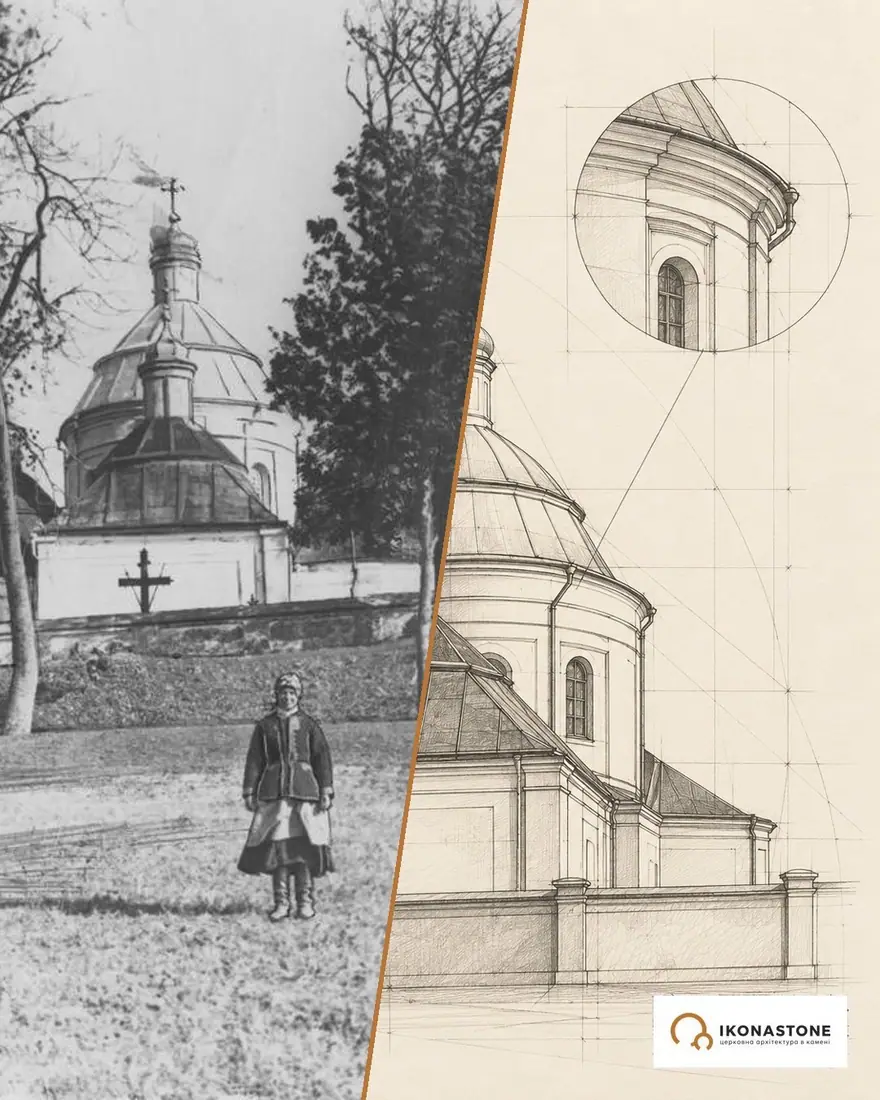
The Baptistery and the Octagonal Font: What They Are and Where the Shape Comes From
There is a place in a church that a person enters once and returns to all their life. It is not the altar table or the iconostasis but a small space in the narthex or a side niche where a vessel of water stands. Here a person is immersed in water or has water poured over them, and enters the Christian community. Everything built around it serves this moment: the space, the light, the stone underfoot.
There is a special word for this place. “Khreshchalnia” is the Ukrainian name for what the European tradition calls a baptistery, from the Greek word “I immerse”. Once it was a separate building, which a city built beside its cathedral as it would build a gate. Today it is more often a corner of the church. But the logic has remained ancient, and it is this logic that explains why the font is so often octagonal.
In brief
- The baptistery is a space for the sacrament of baptism that contains the font. It may be a separate building, a chapel, a niche or part of the narthex.
- The font is the vessel or pool of water itself. A baptistery without a font is just a room; a font without a baptistery is just a vessel.
- The octagonal form has been widespread since the 4th century. It is explained by the symbolism of the eighth day, the day of the Resurrection. This is linked to a verse for the Milan baptistery attributed to Saint Ambrose.
- Historical models: the Lateran Baptistery in Rome, and the baptisteries of Ravenna, Florence and Pisa.
- In Ukraine the early Byzantine baptisteries of Chersonesus are known.
- Today the location, form and material of the font are determined by the rite, the tradition of the community and the design of the church.
What is a baptistery, and how does it differ from a font?
In architectural history a baptistery is defined as a centrally planned building around a font. In the ancient baptisteries the catechumens (those preparing for baptism) were instructed, and in the main hall they were immersed in the water three times.
The font is an object; the baptistery is a place. The difference is similar to that between the altar table and the sanctuary: one is an object, the other the space it organises. A baptistery may consist of a single font in a niche, or it may be a whole building with a dome and mosaics.
Where is the baptistery placed: in the church or separately?
History has known both. Early baptisteries were associated with cathedrals rather than parish churches. In northern Italy separate baptisteries were built beside the cathedral, often with a separate bell tower. But the baptistery also existed within the church itself, sometimes even with its own altar, like a small chapel.
In Catholic practice the guideline Built of Living Stones (United States Conference of Catholic Bishops, 2000) allows different solutions: a font near the entrance, so that everyone who enters recalls their baptism, or on one axis with the altar, to link baptism with the Eucharist. The Rite of Christian Initiation of Adults allows a baptistery in a chapel inside or outside the church.
In Orthodox practice baptism is celebrated by full triple immersion, so fonts are as a rule considerable in size: in antiquity large fixed fonts were placed in separate rooms or chapels, while today portable metal vessels in the form of a large chalice are often used, placed in the narthex or near the entrance.
| Option | When it is justified |
|---|---|
| A separate building | A large cathedral or monastic complex; a place for catechumens and for solemn baptisms |
| A side chapel or annex | A church with a sufficiently large plan, when a quiet, set-apart space is needed |
| Narthex or babynets | Often: a font near the entrance recalls that through baptism a person enters the Church |
| A niche in the nave wall | When space is limited but the font should remain in view |
What does the font mean in the rite?
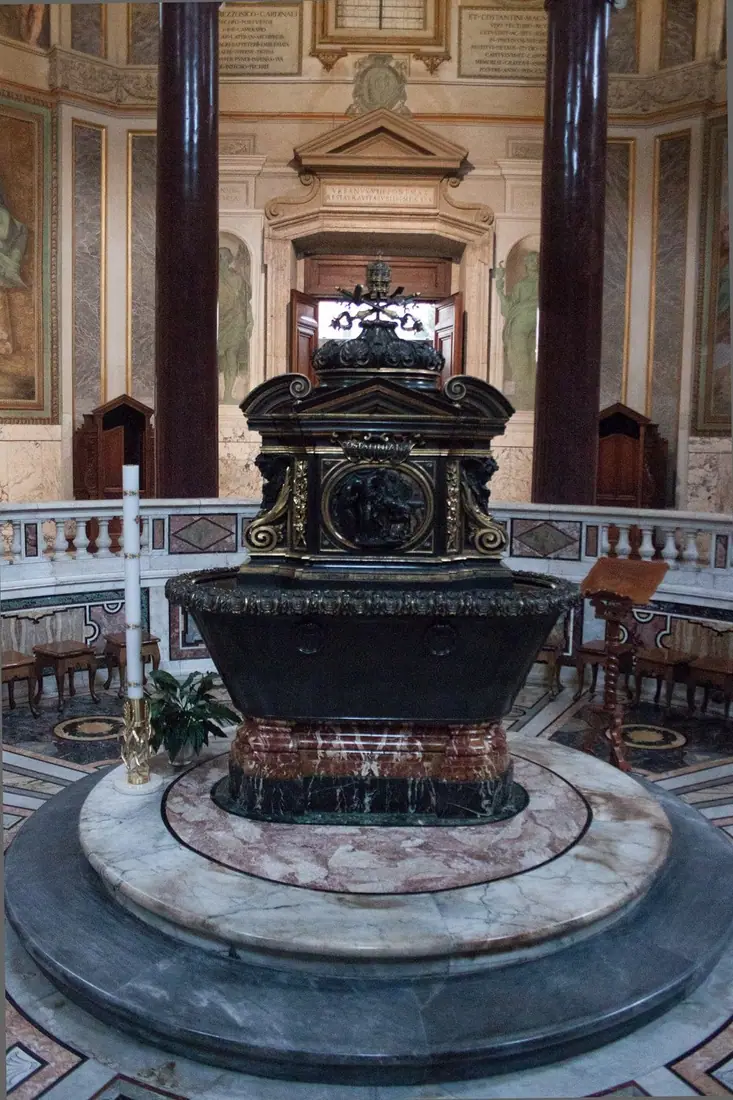
In the Eastern tradition the font is often interpreted through two images: as the womb of the Church, from which a person is born to new life, and as the tomb of Christ, in which they die and rise together with Him. The earliest fonts were built for full immersion, often cruciform, and three steps were associated with the Trinity. When infant baptism spread, fonts became smaller.
These two images, womb and tomb, explain well why a baptistery should feel like a place apart: water here signifies both death and birth, and the architecture speaks of this through form, proportion and silence.
Where does the octagonal form come from?
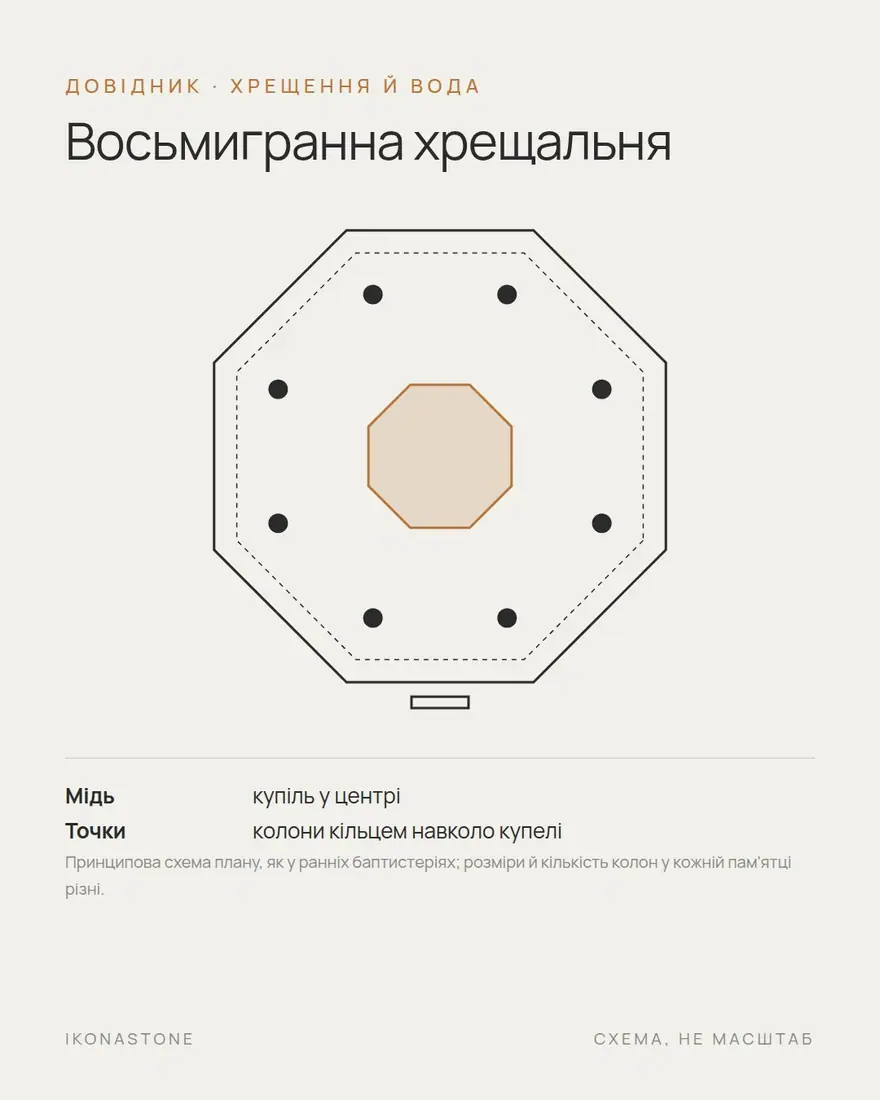
First the fact, then the interpretation. The fact: from the 4th century Italian baptisteries often had eight sides, and the Lateran Baptistery became a model for many others. It is an octagonal building with a large octagonal font in the centre and eight porphyry columns around it. It was founded in 440 by Pope Sixtus III, possibly on the site of an older building.
Now the interpretation. In Milan there are verses known as the Versus Ambrosii ad fontem, “Ambrose’s verses at the font”. They are linked with the Milan baptistery where, on the Easter night of 24–25 April 387, Ambrose baptised Augustine, Alypius and Adeodatus. The first line reads: “Octachorum sanctos templum surrexit in usus, octagonus fons est munere dignus eo”, “A temple of eight niches has risen for sacred use; the octagonal font is worthy of this office”. Researchers render Ambrose’s thought as follows: the font is octagonal because on the eighth day the risen Christ loosens the bonds of death and raises the dead from their graves. The eighth day here is Sunday, which comes after the Sabbath. Augustine, whom Ambrose baptised in this baptistery, also spoke of the eighth day as sanctified by the resurrection of Christ. Researchers caution that the verse only names the symbolic sense of the number eight as fitting for such a font, and that the form may also have had structural and monumental reasons.
So eight is a symbol. The seven days of the week are the time of this world; eight is the day that no one counts any more. Baptism was understood as the first step into this “day without evening”. At the Vatican the Lateran Baptistery is described roughly like this: the form recalls the eighth day, the symbol of the risen Christ. Of the Ravenna baptisteries it is written that the eight sides signify the seven days of the week plus the day of the Resurrection and eternal life.
This explanation also has its limits. It is an interpretation, not an architectural requirement: there were other forms with their own meaning. A cruciform or quatrefoil font recalled the Cross (John Chrysostom: “Baptism is a cross”); the hexagon was associated with the sixth day, Good Friday. The octagon remains the most widespread.
Which baptisteries have come down to us?
Ravenna. There are two baptisteries here, both octagonal. The so-called Orthodox or Neonian Baptistery (as distinct from the Arian) was begun in the late 4th or early 5th century under Bishop Ursus, and the mosaics in the dome appeared under Bishop Neon in the 5th century. They show John the Baptist baptising Christ in the Jordan, with the twelve apostles processing around. ICOMOS calls it the finest and most complete of the surviving early Christian baptisteries. The Arian Baptistery in Ravenna was built by King Theodoric the Great between the late 5th and early 6th centuries; its dome mosaic of the Baptism of Christ is very similar in composition to the Neonian one.
Rome. The Lateran Baptistery, octagonal, of 440 (Pope Sixtus III), became the model for many buildings in Italy.
Milan. Ambrose’s baptistery with eight niches survives in fragments: six niches and part of the mosaic floor. The font in the centre, according to the description, is round, sunk into the floor, with a channel for water. The ruins were found in 1879 during sewer works and rediscovered in 1943.
Florence. The Baptistery of Saint John the Baptist is an octagonal building dedicated to the city’s patron saint. A consecration date of 1059 was long current, but researchers have shown that it is inaccurate; the building’s origin is now placed in the 11th–12th century. The dome mosaics were created roughly between 1240 and 1300, and the bronze doors were made by Andrea Pisano and Lorenzo Ghiberti.
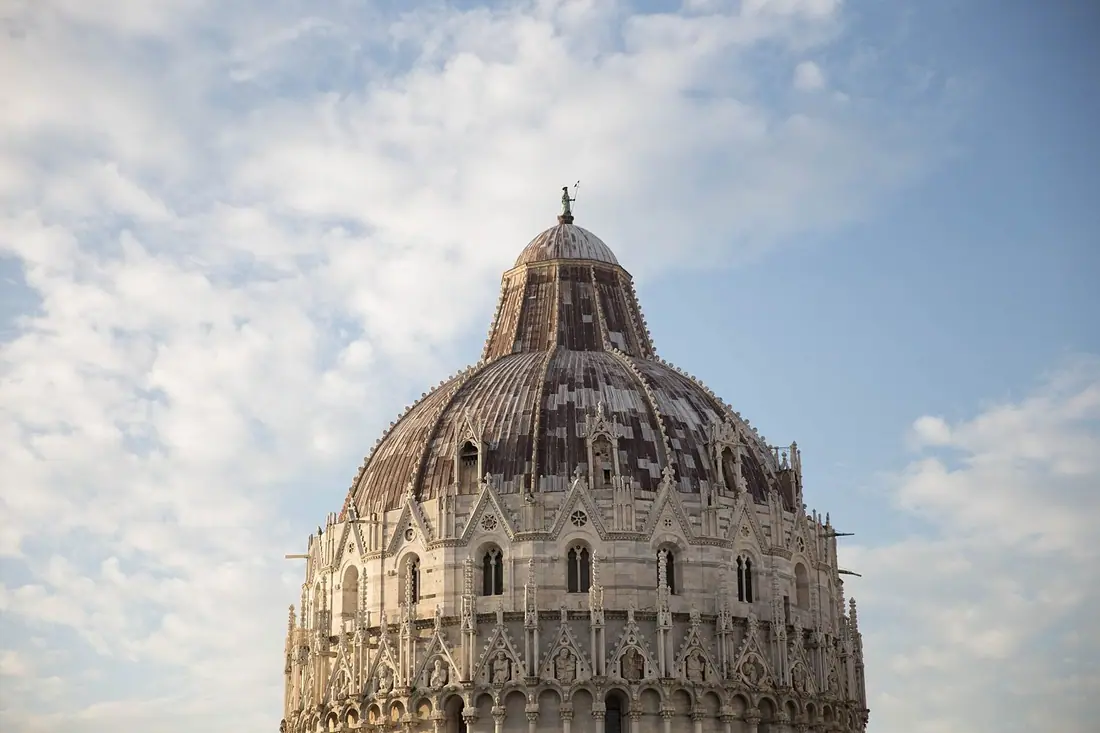
Pisa. The baptistery was begun in 1152 and completed in 1363; the building itself is circular in plan. It is the largest baptistery in Italy: about 34 m in diameter and almost 55 m high. The octagonal font inside is dated 1246, and the pulpit was carved by Nicola Pisano in 1255–1260.
In Ukraine. Early baptisteries are known in Chersonesus. According to Mykhailo Fomin’s article on the building activity of Bishop Capito in the 4th century, the pagan complex on the city’s Eastern Cape was dismantled and the Basilica of the Apostle Peter was built in its place, with a baptistery rising beside it. There is also a separate study, “The Baptisteries of Chersonesus” (National Academy of Sciences of Ukraine), on the rite of baptism in the early Byzantine period.
How is a baptistery arranged today?
The practical criteria grow out of the rite, not out of fashion.
- The rite determines the size. Catholic guidelines state that the font should hold enough water for an adult to kneel while water is poured over them, and should also have a section for immersing an infant. In Orthodox practice baptism is celebrated by full triple immersion, so the vessel is correspondingly large, often in the form of a large chalice, made of metal.
- Location. Catholic guidance requires that the font be visible and accessible to all who enter the church.
- The material matches the altar. Catholic guidance recommends choosing materials and features similar to the altar, so that baptism and the Eucharist read as parts of one path. For a stone church this is natural: the same stone, the same finish of the edges.
- Water and drainage. A font needs a water supply and drainage, a sloped bottom, handrails for the steps. This is an engineering task solved at the design stage, not after installation.
- Symbolism. Eight sides, three steps (the Trinity), a cross on the cover or on the side. The details are chosen by the client together with the priest.
A separate topic is the vessel for blessed water that the faithful take home with them: in Eastern practice it has long been placed in the narthex or near the entrance. Read about it in the article on the holy water basin.
What to decide before ordering
- Rite and tradition. How will baptism be celebrated in this church: immersion, pouring, both? The size and depth depend on this.
- Location. Narthex, babynets, side chapel, separate building. Is there enough floor area for the font, the priest, those being baptised and their sponsors?
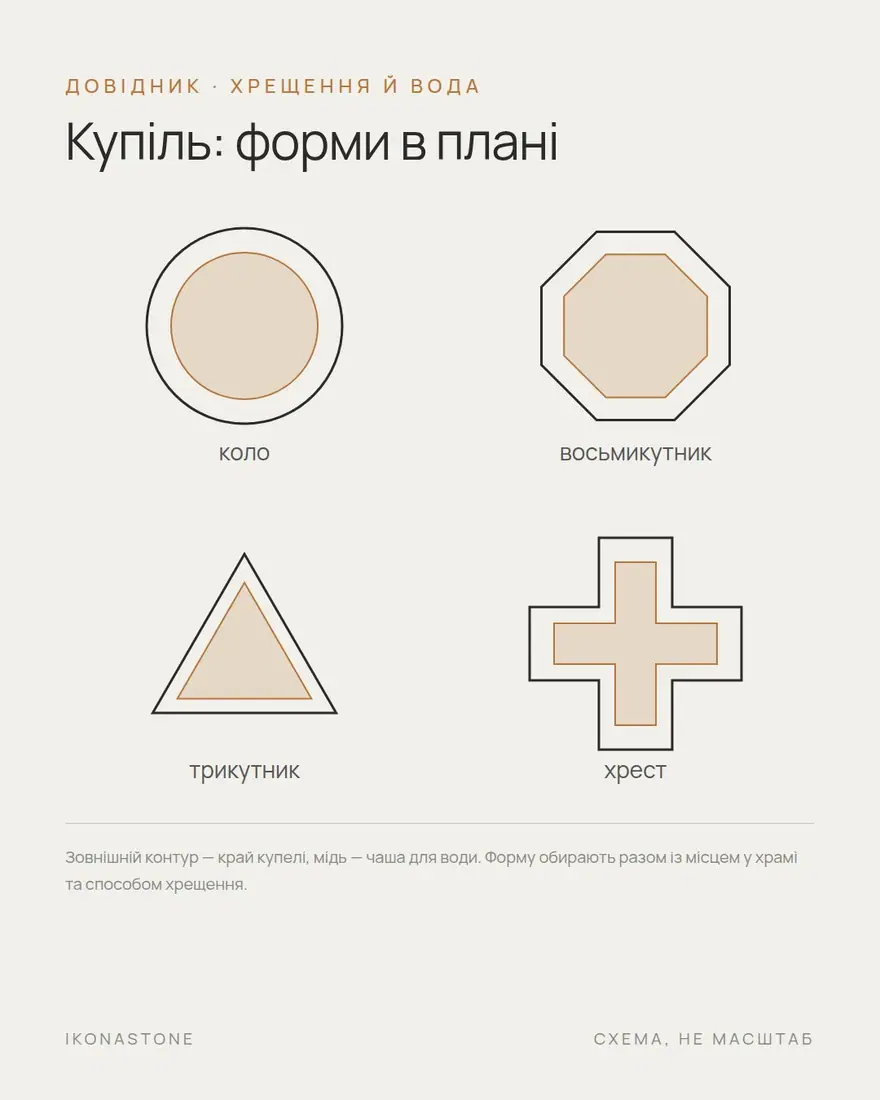
- Form and symbolism. Octagon, circle, quatrefoil. Are a cross, steps or an icon of the Baptism of the Lord above the font needed?
- Material. Marble, granite, sandstone. Coordinate with the floor, the altar table and other stone elements.
- Water. Supply, drain, heating, protection against freezing if the font stands in an unheated narthex.
- Approval. The requirements of the diocese, the rector, the architect or designer of the church.
- Lighting and care. What to clean the stone with, how not to damage the surface.
Where to go next
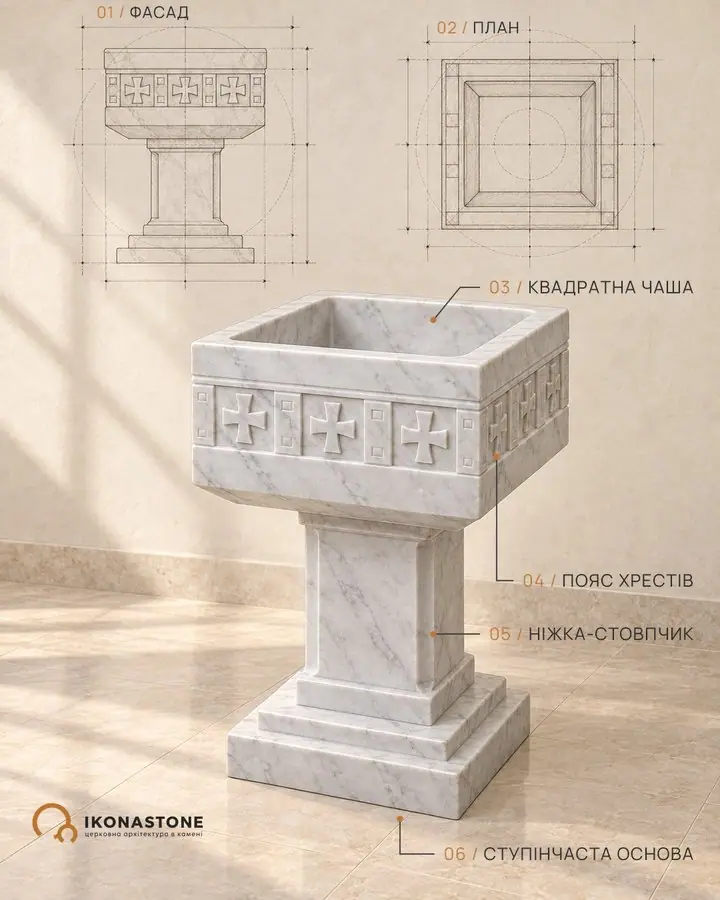
A baptistery is small in area, but architecture, rite and biblical symbolism all meet in it. At the IKONASTONE workshop, fonts and basins for churches are made in stone to the client’s design and with the rector’s approval. Examples and materials are collected in the fonts and basins section. On related topics: a baptismal font for a church and the holy water basin. For small buildings where the baptistery is planned as a separate chapel, see also chapels.
Not sure what the piece is called? Walk through the church from sanctuary to churchyard →
Would you like to give something to a church? What to give a church →
Want to remember loved ones or a fallen parishioner? Remembrance at a church →
FAQ
What is a baptistery?
It is a room or a separate building where the font is located and the sacrament of baptism is celebrated. The word comes from the Greek "baptizo", "I immerse". In Ukrainian the corresponding word is "khreshchalnia".
How does a baptistery differ from a font?
The font is the vessel or pool of water itself. The baptistery is the space that contains it: a separate building, a chapel, a niche or a set-apart part of the narthex.
Why is the font often octagonal?
In Christian symbolism the number eight is associated with the eighth day, the day of the Resurrection. This symbolism is linked with a verse attributed to Saint Ambrose of Milan and intended for the Milan baptistery. According to researchers' accounts, Ambrose explained the octagonal form by the fact that Christ rose on the eighth day.
Must a baptistery be built separately from the church?
No. Since antiquity the baptistery has been both a separate building and part of the church. Today it is often arranged in the narthex, the babynets, a side chapel or a niche. The final decision is made by the rector in accordance with the requirements of his diocese.
What material is a church font made of?
Fonts are made of stone (marble, granite, sandstone) or metal. Stone is durable and harmonises with other stone elements of the interior. The material and size are chosen to suit the rite that will be celebrated there.
Were there baptisteries on the territory of present-day Ukraine in ancient times?
Yes. Researchers write about the baptisteries of early Byzantine Chersonesus: according to an article by Mykhailo Fomin, a baptistery stood beside the Basilica of the Apostle Peter in the 4th century.
Sources 15
- Baptistery — Wikipedia
- Baptismal font — Wikipedia
- Huyser-Honig J. Theological Reasons for Baptistry Shapes (Calvin Institute of Christian Worship)
- Milan: the Baptistery of Ambrose and the baptism of Augustine (Cassiciaco)
- The Christian Ogdoad — Dialogues d'histoire ancienne / Anales (UCM)
- Basilicas of the Vatican: The Constantinian Baptistery
- Lateran Baptistery — Wikipedia
- Neonian Baptistery, Ravenna — Wikipedia
- Arian Baptistery, Ravenna — Wikipedia
- Florence Baptistery — Wikipedia
- Pisa Baptistery — Wikipedia
- Fomin M. On the building activity of Bishop Capito in Chersonesus–Cherson in the 4th century (Drinov Collection, vol. 13, 2020)
- The baptisteries of Chersonesus (on the history of the baptismal rite in the early Byzantine period) — National Academy of Sciences of Ukraine, repository
- Font — OrthodoxWiki
- Style and location of baptismal fonts (Archdiocese of Canberra and Goulburn; after Built of Living Stones, USCCB)