Stone relief for a church: the Agony in the Garden and the light
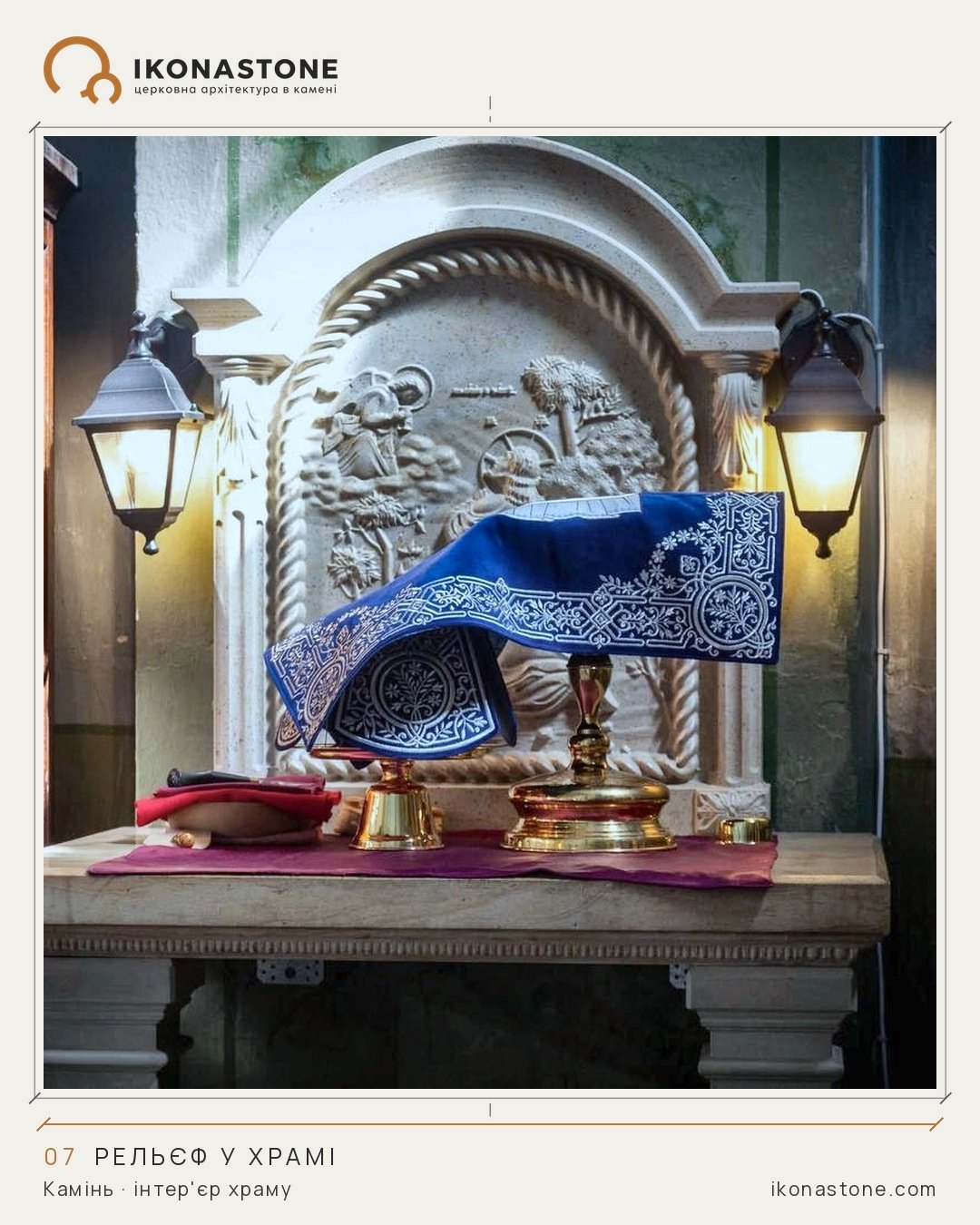
Light brings a relief out, or wipes it away. The photograph shows a stone relief for a church: an arch outlined with a rope moulding, pilasters with leaf capitals on either side, and at the centre Christ in the Garden of Gethsemane with an angel. Side lanterns light the scene from the side, and the figures read as solid forms.
The Agony in the Garden: what the scene is
After the Last Supper, on the night of the arrest, Christ goes with His disciples to pray. Matthew and Mark call the place Gethsemane (Matt. 26:36; Mark 14:32), Luke calls it the Mount of Olives (Luke 22:39), and John mentions a garden across the Kidron brook (John 18:1). Hence the usual name: the Garden of Gethsemane.
The scene takes its name from the words of the prayer itself: “Father, if thou art willing, remove this cup from me; nevertheless not my will, but thine, be done” (Luke 22:42, RSV).
The angel in the Garden of Gethsemane: a detail from Luke’s Gospel
Only Luke tells of an angel who appeared from heaven and strengthened Christ (Luke 22:43). In Matthew and Mark this detail is absent: there, only the disciples are nearby, and they are asleep.
So a relief in which an angel comes to Christ shows the scene as Luke recorded it. Not the anguish itself, but the moment when strength comes.
Stone relief in a church interior: how light works
A relief depends on shadow. Light falling at a shallow angle to the surface brightens the faces turned towards the source and deepens the shadows on those turned away. The shallower the angle, the more pronounced the modelling, up to the point where long shadows begin to hide neighbouring forms.
The opposite case is several sources from different sides. They cancel one another’s shadows, and the carving is “washed out”.
So the depth of the carving and the direction of the light are one decision, not two. Stone is harder to rework than a lantern is to rehang, but it is best to do neither.
Stone relief for a church: the arch and the frame of the scene
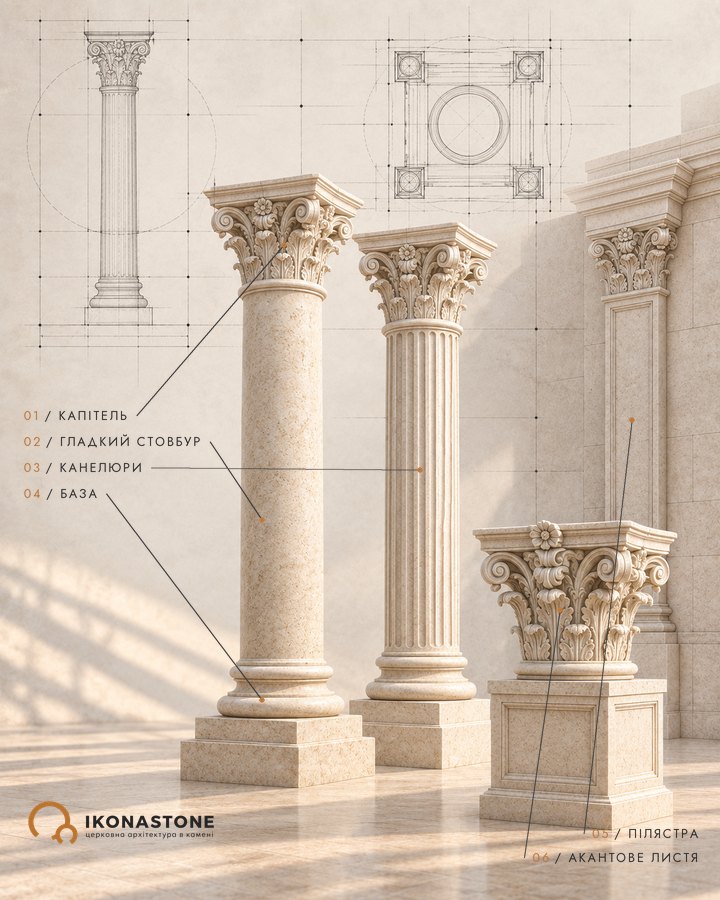
A pilaster is a flat, column-like projection of the wall. Here the pilasters with leaf capitals stand on either side of the arch, and the arch itself is outlined with a rope moulding. Stone pilasters and capitals work as a portal: they draw the eye and separate the scene from the plane of the wall.
What to decide before ordering
- Where the light will fall from. Windows, lanterns, candle stands: the direction determines how deep the carving needs to be.
- Subject and composition. How many figures and what stands at the centre: this sets the scale of the whole.
- The surround. Arch, pilasters, capitals: whether they are part of the relief or part of the wall.
- Viewing distance. Where the relief will most often be seen from.
Questions and answers
What if the lighting in the church is already installed? Then the design starts from it. Along with a photograph of the wall, add one with the lanterns switched on: this shows where the shadows will fall.
Can a relief be made with a different subject? Yes. We begin with a photograph and the dimensions of the site, then the sketch and drawing, approval, fabrication and installation.
What stone is an interior relief made from? We choose the stone for the specific place, subject and lighting. This is decided at the sketch stage.
If you are planning a relief for your church, send a photograph of the wall and mark where the light falls from, and we will suggest the depth of the carving: +380 66 892 98 18. More about this line of work is on the Columns, pilasters, capitals page.