Stone cross with the Crucifixion: how to read it from the bottom up
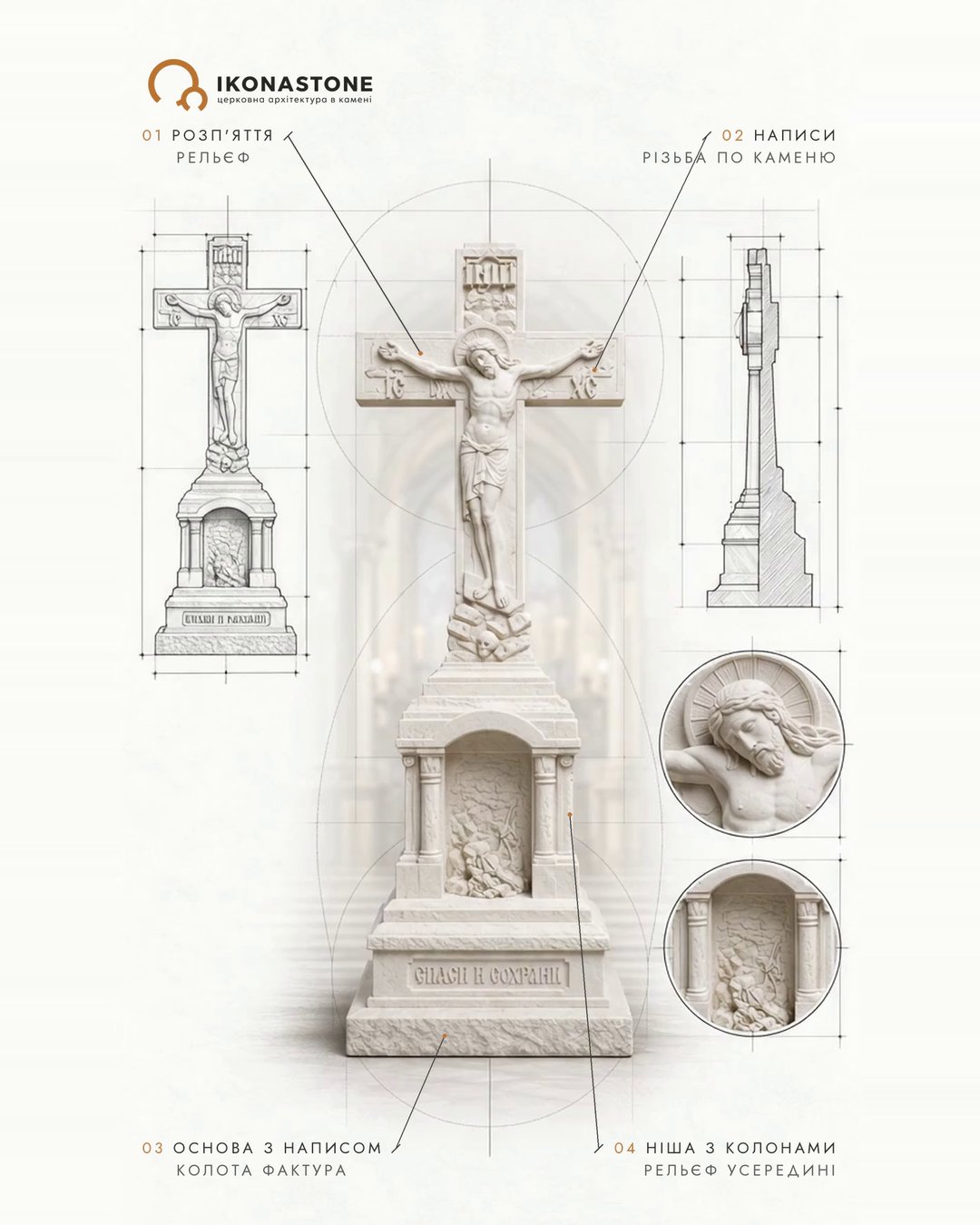
The main details on this cross are not “for show”. A stone cross with the Crucifixion reads from the bottom up, like a story: base, niche, Golgotha, Crucifixion. The video is an architectural presentation of such a cross, with its details labelled.
A stone cross with the Crucifixion: four tiers of one story
We begin with the base. It is stepped and carries an inscription: the stone rises in ledges, and the eye follows it up.
Above it is a niche with two columns and a relief inside. This is a pause before the main thing: a smaller architecture within a larger one.
Higher still comes Golgotha with the skull, and only then the Crucifixion with its inscriptions. Each tier prepares the next. Remove one, and the story breaks off mid-sentence.
The stepped base: why the cross stands on ledges
A cross on steps is an ancient motif, and it is called the Golgotha cross. On Byzantine coins it appears as early as the end of the 6th century, under the emperor Tiberius II, and in the 7th century, under Heraclius, it becomes common.
There is a plain practical side too: the ledges widen the support towards the bottom, and the vertical stands steady.
What the skull beneath the Crucifixion means
The name “Golgotha” means “skull”. In Ukrainian translations of the Gospel the place is called Лобне місце (Lobne mistse) or Череповище (Cherepovyshche), both meaning “the place of the skull” (John 19:17).
According to Church tradition, Adam was buried on Golgotha, and the Cross of Christ was set up over his grave. That is why the skull at the foot of the Crucifixion is called the head of Adam. Origen already mentioned this tradition in the 3rd century.
The meaning of the image lies in the words of the Apostle Paul: “as in Adam all die, so also in Christ shall all be made alive” (1 Cor. 15:22, RSV). Here the skull is not a sign of death but the beginning of a conversation about death overcome.
Inscriptions on the cross: ІНЦІ and IC XC
At the top is a board with an inscription. According to the Gospel, Pilate had an inscription placed on the cross, “Jesus of Nazareth, the King of the Jews”, in three languages (John 19:19–20). Hence the abbreviation we usually see in this place: INRI in Latin, ІНЦІ in the Church Slavonic tradition.
On the arms is “IC XC”, the abbreviated form of the name “Jesus Christ”: the first and last letters of each of the two Greek words. Such abbreviations are written under a titlo, the superscript mark of old writing.
A cross by the church: scale is set by the place
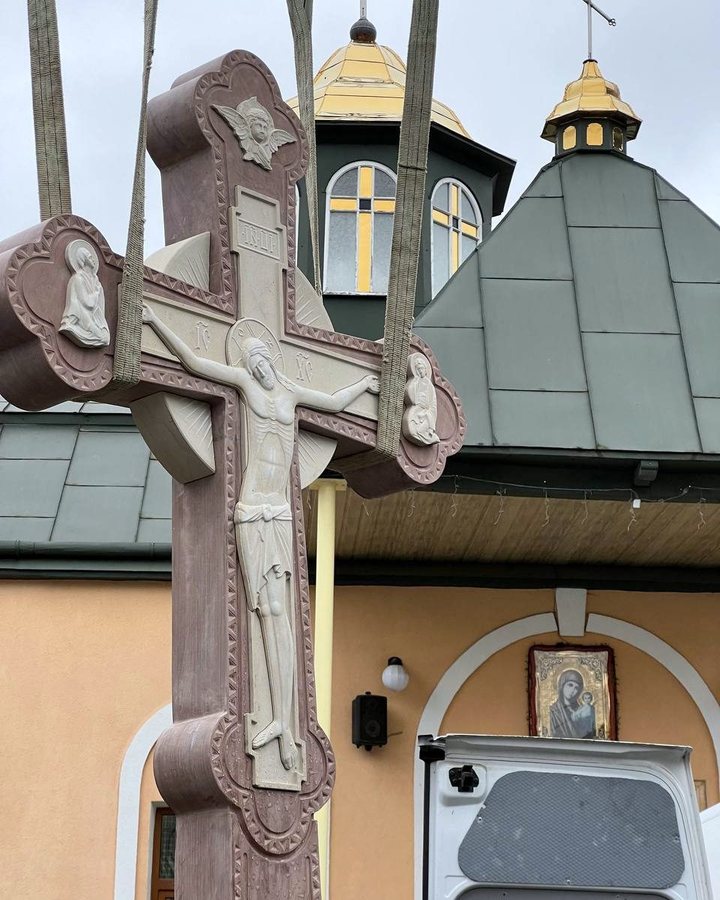
Such a cross is designed for two distances. From afar the silhouette does the work: the vertical and the arms. Up close it is the relief, the niche, the letters.
So the height is chosen not from a sheet of sketch paper but from the place. The church grounds, a chapel, a crossroads: three different answers to the same question.
What to decide before ordering
- Place. Church grounds, chapel or crossroads: the height and proportions depend on it.
- Inscriptions. The text on the base and on the title board, the language and the style of lettering are best agreed with the parish in advance.
- Relief in the niche. The subject inside is decided before the drawing, not after.
- Support. Stone is heavy, so the cross needs a level and solid foundation.
Questions and answers
Why is a skull shown beneath the Crucifixion? It is the head of Adam. According to tradition, Adam was buried on Golgotha, and the Cross of Christ was set up over his grave.
What does ІНЦІ on the cross mean? It is the abbreviation of the inscription “Jesus of Nazareth, the King of the Jews” (John 19:19) in the Church Slavonic tradition. The Latin equivalent is INRI.
Can a cross with a different inscription or relief be ordered? Yes. We begin with a photo and the dimensions of the place, then a sketch and drawing, approval, fabrication and installation.
We design crosses like this for a specific place. Send a photo and we will advise on scale: +380 66 892 98 18. More about this line of work is on the Crosses page.