A stone altar table: four columns and a vine
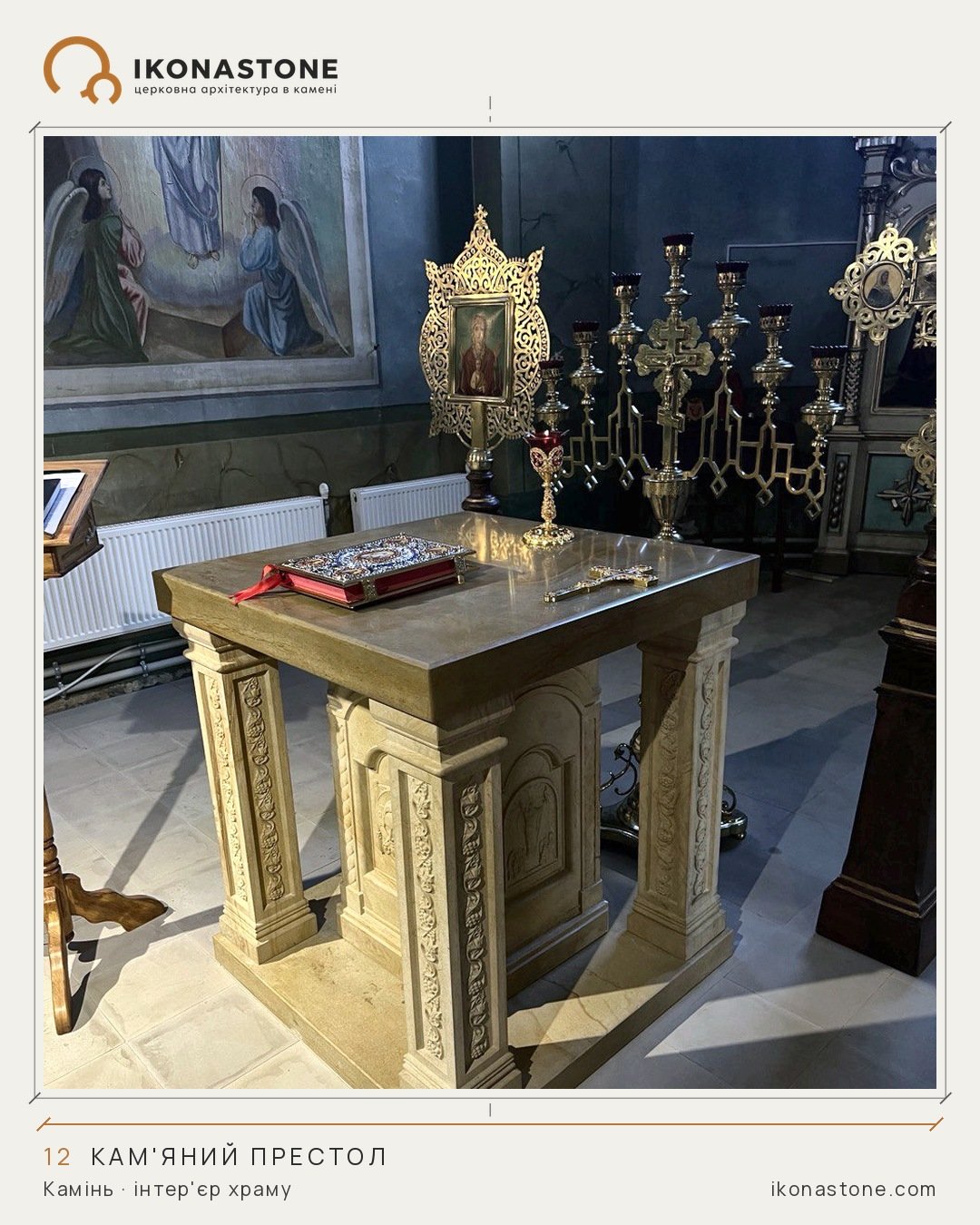
A slab on four columns, and a vine winding round the columns. This stone altar table stands in the sanctuary of a church; on the slab lie the Gospel and a cross. Let us look at how it is put together and what its carving means.
A stone altar table in a church: what it is
A dictionary of church terminology explains it briefly: the altar table is the table in the middle of the sanctuary on which the Holy Gifts are consecrated. It symbolises the tomb of the Lord and, at the same time, the throne of Christ’s divine glory. The Law of God calls it the holiest place in the church.
It is also called the Holy Table; that is the custom in the Greek-Catholic tradition, among others.
Among the things that must be on the altar table, both sources name the Gospel and the cross. These are exactly what can be seen here on the slab. And one more rule from the same texts: only the clergy may touch the altar table.
An altar table with carved columns: how it is put together
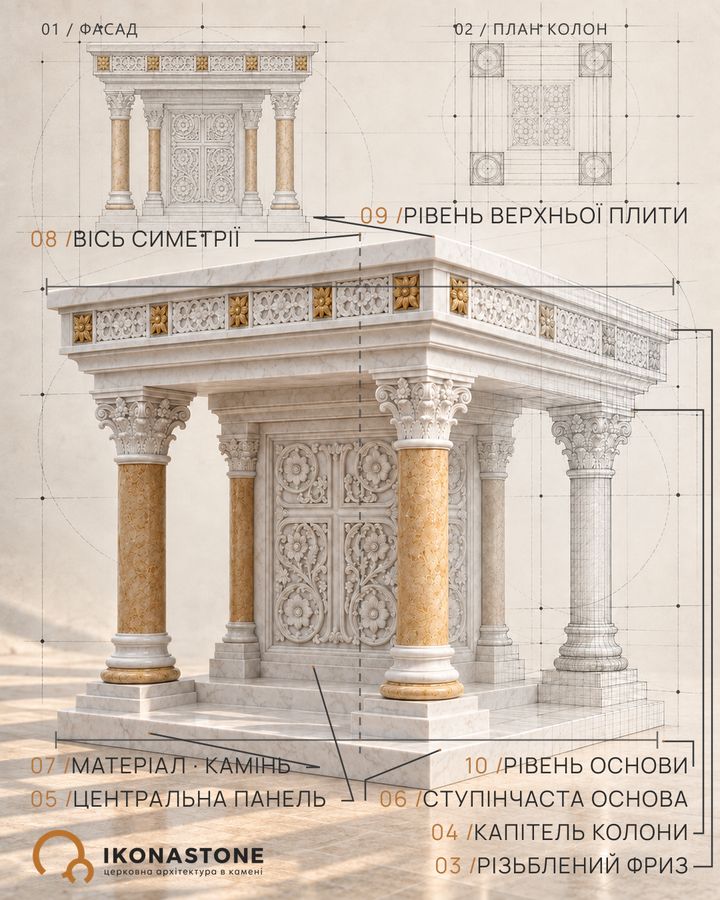
The structure is as simple as that of a table. The top slab rests on four columns. Between them is a central block with arched niches and a relief.
Four supports follow the logic of a table: the slab lies, the columns carry it. The central block between them provides a surface with room for relief. And the arch of the niche, on a small scale, speaks the same language as church architecture as a whole.
This describes one solution, not a rule. Altar tables come in other forms too.
The vine on the altar table: what the ornament means
The vine is an ancient Eucharistic symbol. The motif of a vine branch with grapes as a sign of the Eucharist has been known in sacred art since early Christian times.
Behind it stand Christ’s words in the Gospel of John: “I am the true vine, and my Father is the vinedresser,” and further on, “I am the vine, you are the branches” (John 15:1, 5; RSV).
The Eucharist is celebrated on the altar table. So the vine on its columns is not ornament “for the sake of beauty” but an image in its proper place.
A stone altar table for a church: why everything is decided before the stone goes on the machine
Once installed, a stone altar table can no longer be “moved a little”. So the height, the size of the slab and the passage around it are decided before the stone goes on the machine.
The dimensions are agreed with the rector on the drawing. The drawing here is not a formality but the only place where the altar table can still be moved.
What to decide before ordering
- The height of the altar table and the size of the slab. They are agreed with the rector on the drawing.
- The passage around it. How much space remains between the altar table, the iconostasis and the walls of the sanctuary.
- The carving. What will be on the columns and in the niches of the central block: vine, cross, relief.
Questions and answers
Can a stone altar table be moved after installation? It cannot be “moved a little”. So the place and dimensions are settled on the drawing, before work on the stone begins.
Why is a vine carved on the altar table? It is a Eucharistic symbol. It rests on Christ’s words about the vine and the branches (John 15:1–5).
What does work on an altar table begin with? With a photograph and the measurements of the place. Then a sketch and a drawing, approval, fabrication and installation.
If you are planning an altar table for a church, send us a photograph of the sanctuary and its dimensions and we will suggest the proportions of the slab and supports: +380 66 892 98 18. More about this line of work on the Altar tables page.