Red granite cross and a Nativity icon on stone
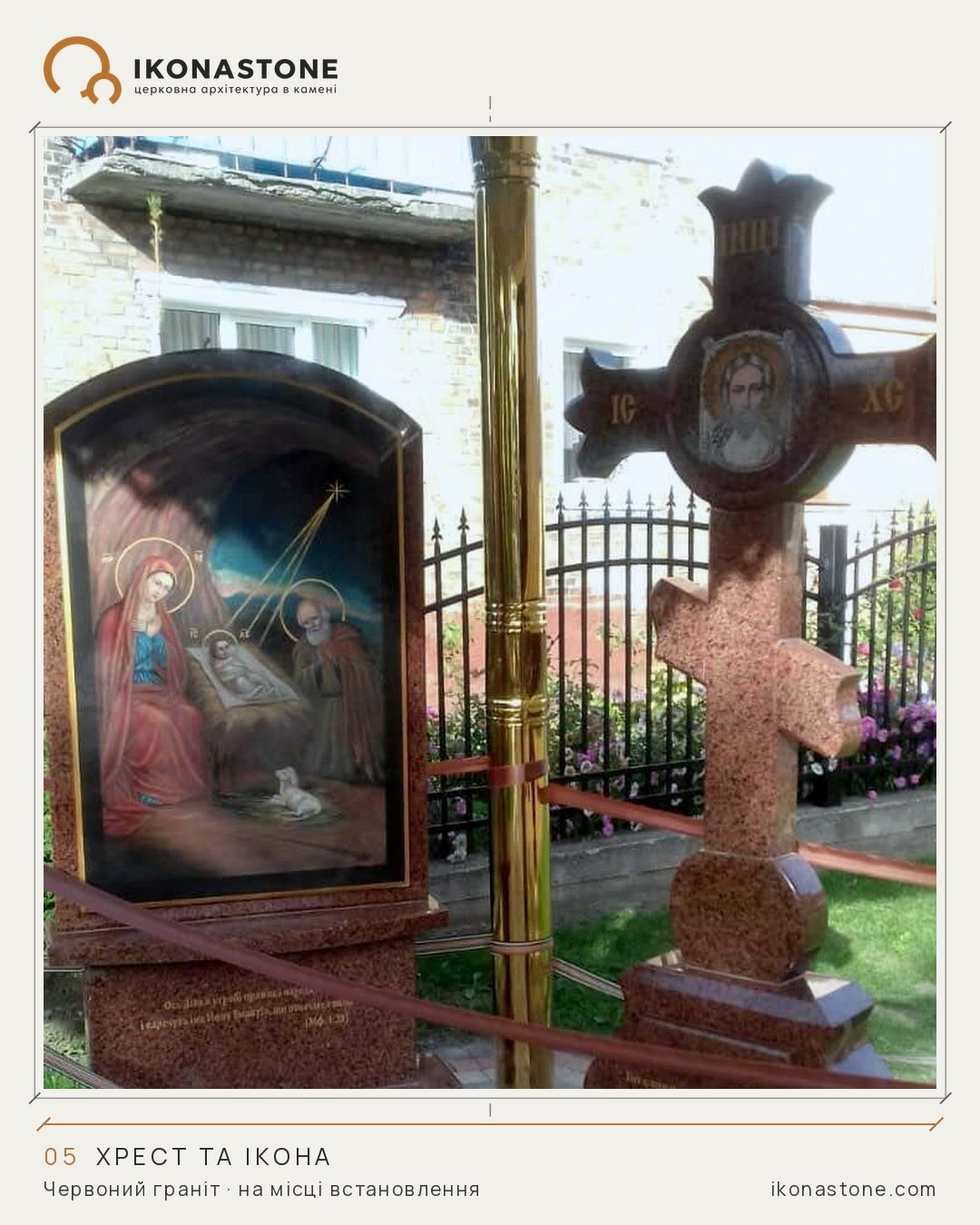
Two pieces stand side by side and read as one. A red granite cross with a round image of Christ at its centre, and next to it a dark arched slab with a colour Nativity on a base of red granite. The photograph was taken at the installation site: a fence and flowers close by.
A cross and an icon by a house or a church: one composition
The cross is a vertical with shaped ends. The slab is an arch. Separately they are two objects; together they share out the roles: the cross is seen from afar, the image is looked at from close up.
Stone ties them together. The red granite of the cross is repeated in the base under the slab, and the eye reads this as a single design. The dark field of the slab, meanwhile, gives the coloured image a background that red stone would not.
The rule is the same for the church grounds and for a place by a house: first decide what leads and what answers.
A granite cross with an image: what the letters IC XC mean
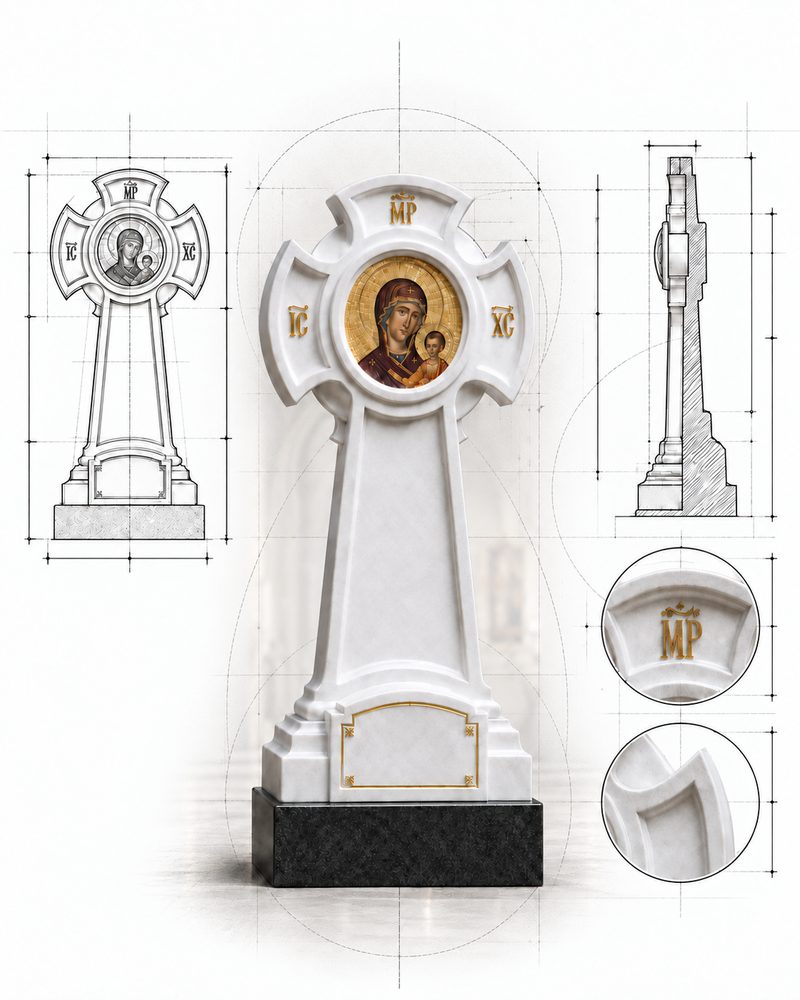
At the centre of the cross is a round image of Christ, and on the arms are the letters IC and XC. These are the first and last letters of the Greek words for “Jesus” and “Christ”. On icons the abbreviation is split in two in the same way: IC to the left of the image, XC to the right.
An icon of the Nativity of Christ on stone: manger, star, lamb
The slab shows the Mother of God, the Child in the manger, Joseph, a ray from the star, and a lamb. Two evangelists tell of the Nativity, and each has his own details.
The manger comes from Luke. Mary wrapped her Son in swaddling cloths and laid Him in a manger (Luke 2:7), and it was the manger that became the sign for the shepherds: “And this will be a sign for you: you will find a babe wrapped in swaddling cloths and lying in a manger” (Luke 2:12, RSV). The shepherds came and found Mary, Joseph and the Child (Luke 2:16).
The star comes from Matthew. It went before the wise men from the East until it stood over the place where the Child was (Matt. 2:9). In the icon this movement becomes a ray pointing to the Infant.
Neither Matthew nor Luke mentions animals beside the manger. The lamb can be read as a reminder of the shepherds who were keeping watch over their flock that night (Luke 2:8).
The Nativity of Christ is on 25 December by the Revised Julian calendar; in communities that keep the Julian calendar, it is on 7 January by the new style.
A red granite cross: stone for the open sky
Granite is an igneous rock rich in quartz and feldspar. Its colour depends on its mineral composition: the stone may be white, grey, pink or red.
Out of doors, something else matters. Granite is hard enough to resist abrasion, resistant to weathering, and polishes well. That is why it is used for monuments and structures that stand in the open.
What to decide before ordering
- What leads. The cross or the image: one leads, the other answers.
- A shared stone. What will tie the pair together: the type of stone, the base, the height.
- The subject of the image. How many figures and details: the more there are, the larger the slab.
- The inscription on the base. The text and the size of the letters are needed before the sketch.
Questions and answers
Can another subject be chosen instead of the Nativity? Yes. The subject is chosen by the person ordering; the outline and size of the slab are suggested by the place.
Can the cross and the image be designed separately? Better together. Then the height, the base and the distance between them can be seen on one drawing.
Where to begin? With a photograph and the dimensions of the site. Then the sketch and drawing, approval, fabrication and installation.
If you are planning a cross or an image for your own site, send us a photograph and the dimensions, and we will suggest how to bring them into one composition: +380 66 892 98 18. More about this line of work is on the Crosses page.