Granite steps for a church: surface, colour and handrails
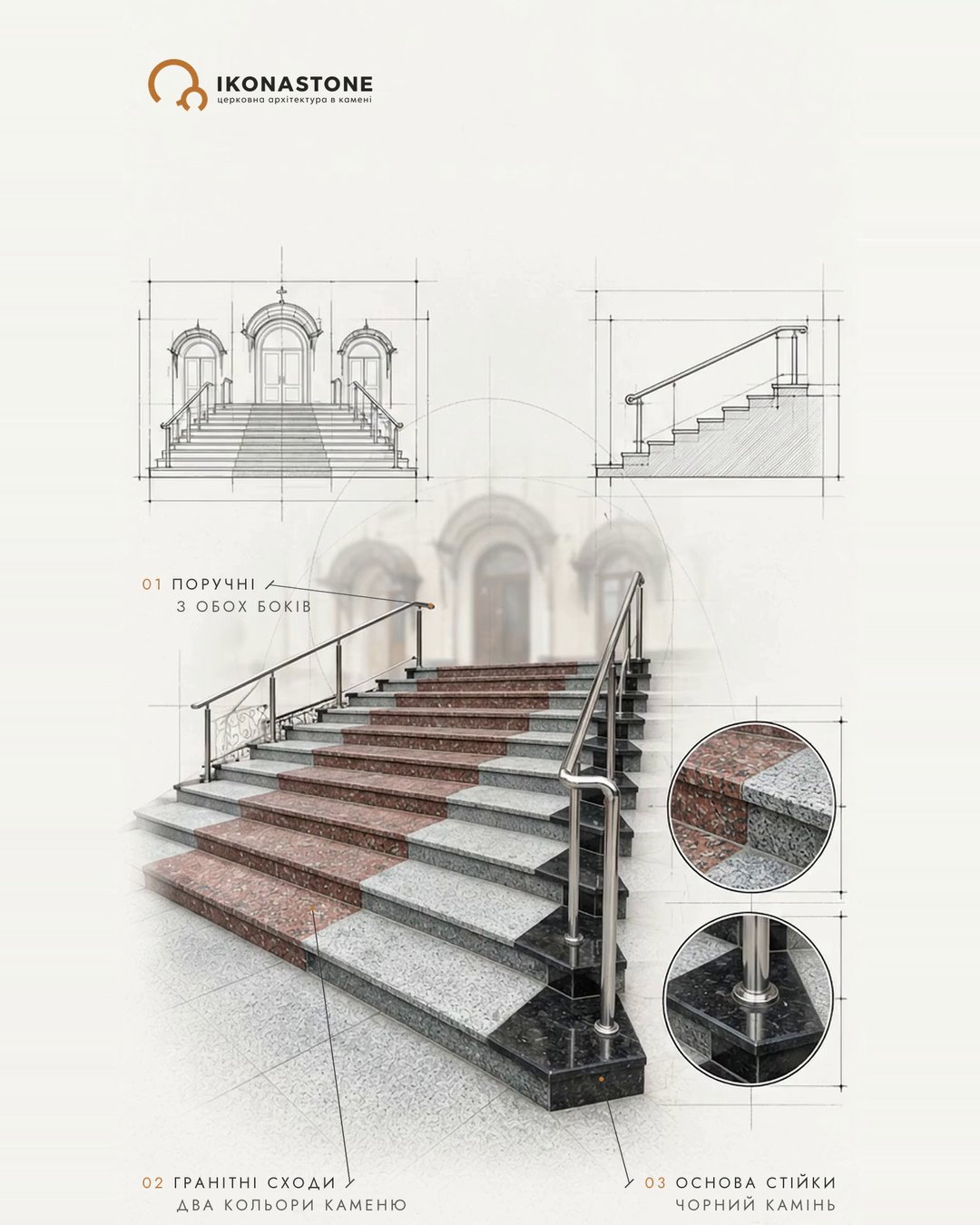
On the way to a church, the steps are the first thing a person sets foot on. Nobody studies the stone here: it is walked on, in rain and in snow, every day. The video is an architectural presentation: granite steps for a church, with two colours of stone and handrails.
Why granite steps are a fitting choice for a church
Granite is a plutonic igneous rock made of quartz, feldspar and mica. It is dense, absorbs little water, withstands frost well and wears away slowly.
On a façade these properties stay almost unnoticed. On a step that the parish walks over every day, they are the main requirement.
Granite steps: surface matters more than shine
Polished granite looks fine on a wall but lets you down underfoot: as soon as water reaches it, it becomes slippery. For this reason a polished surface is not recommended for outdoor steps.
The surface is made rough instead. Flaming (thermal treatment) is done with the flame of a gas torch: the top layer of the stone flakes off and a rough texture remains. Bush-hammering gives an evenly rough surface on which a shoe grips much better.
The Ukrainian State Building Norms on inclusivity (DBN V.2.2-40:2018) say the same: open-air steps must have a slightly rough surface.
Two colours of granite: why a strip down the middle
On these steps the treads are grey, with a red-brown strip down the middle. Here colour is not decoration but a guide: it holds the axis of the entrance and leads to the doors.
It is the same idea as a carpet runner, only said in stone. It does not have to be unrolled for a feast day and rolled up afterwards.
Handrails for church steps: on both sides
The handrails here run on both sides, and the post stands on a base of black stone. The same norms require handrails on both sides of open-air steps, but it is not only a matter of the norms.
Elderly people go to church, and so do parents carrying children. For them a handrail is not a decorative detail but the thing without which the steps to the church remain an obstacle.
The base under the post is a small thing that pulls everything together: the post does not “grow” out of the step but has a place of its own.
What is calculated when steps are designed
The number of steps, their width and the handrails are calculated from the particular entrance, above all from the difference in height between the ground and the threshold.
The building norms also contain a simple rule: all steps within one flight must have the same tread depth and the same height. The foot gets used to the rhythm on the second step, and does not forgive it when the third one is different.
What to decide before ordering
- The entrance. The difference in height and the width: they determine the number of steps.
- The surface. For outdoors, a rough texture, not a polished one.
- The colour. One stone or two; if two, where the axis will run.
- The handrails. On both sides, and what the post will stand on.
Questions and answers
Are granite steps slippery in the rain? It depends on the surface. Polished granite is slippery as soon as it gets wet; for outdoor steps a rough texture is used, either flamed or bush-hammered.
How many steps does a church entrance need? This is calculated from the difference in height between the ground and the threshold. That is why we start with a photograph and the dimensions of the entrance.
Can two colours of granite be combined? Yes. On these steps colour works as a guide: the strip in the middle leads to the doors.
We design steps like these for a particular church. Send a photograph of the entrance and we will suggest a solution: +380 66 892 98 18. More on the Design and installation page.