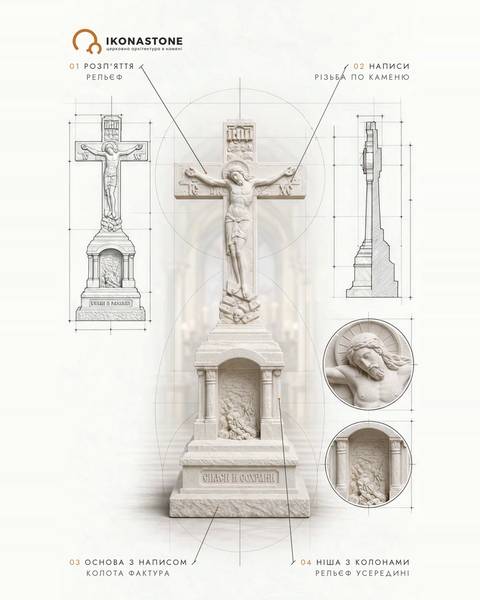
Cross with an icon of the Mother of God: white marble, black granite
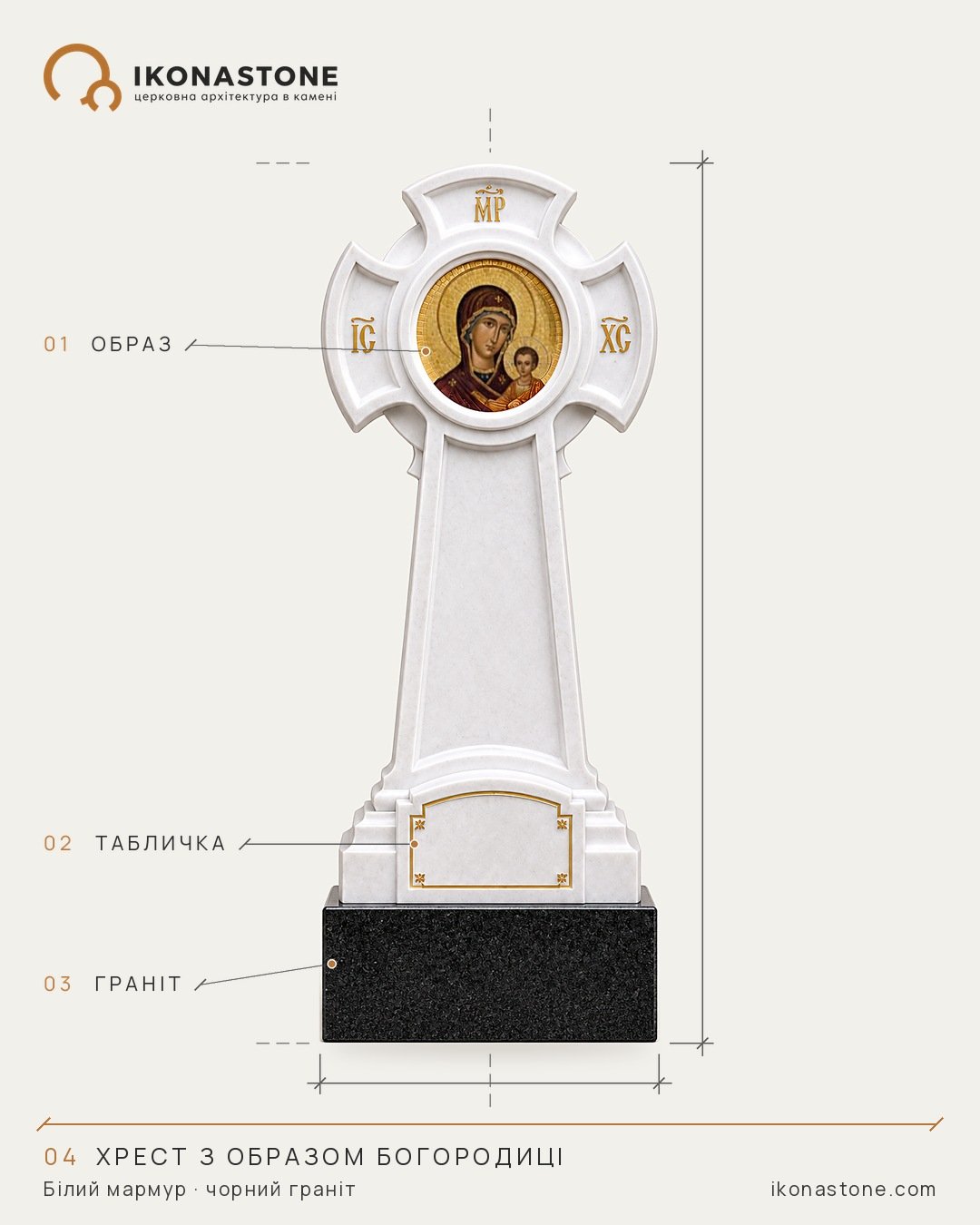
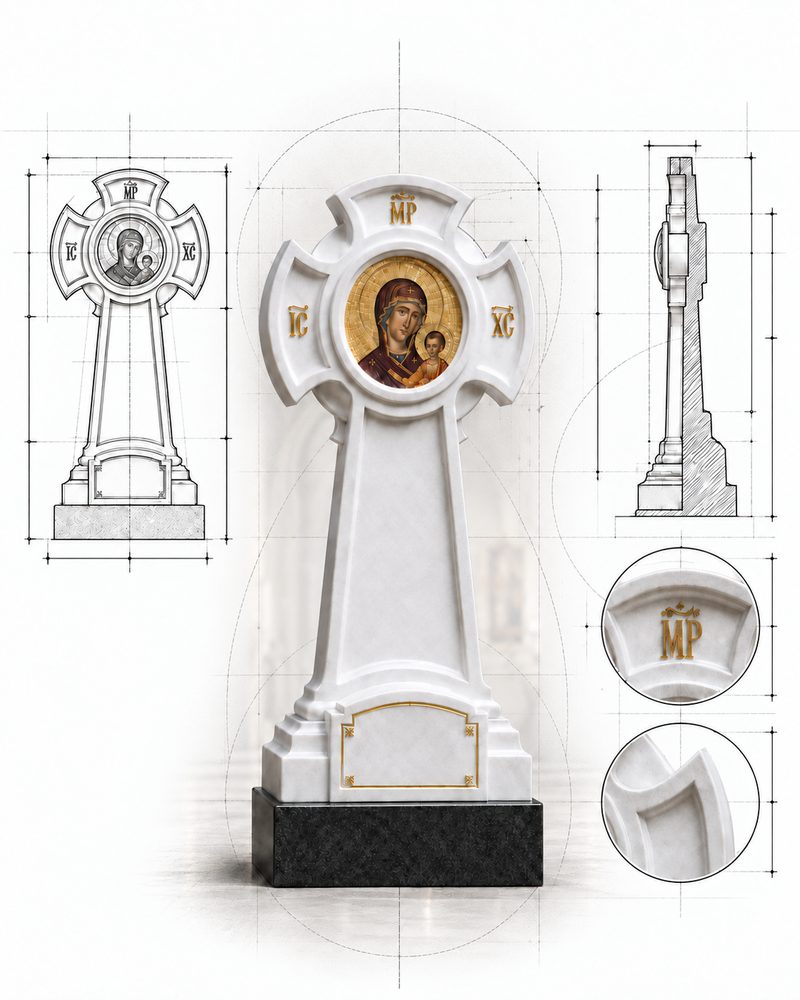
The centre of this cross is not empty. Where the upright meets the arms there is a round image of the Mother of God with the Child on a gold ground. The cross with an icon of the Mother of God is shown in a presentation image with dimension lines: white marble, black granite and three labelled details (the image, the plaque, the granite).
A cross with an icon of the Mother of God: why the image is at the centre
The crossing is the point where the eye arrives of its own accord: all four ends lead to it. An image in this place does not have to be looked for.
A circle does not quarrel with a cross. The arms spread out from it as from an axis, and the widened, rounded ends repeat the same soft line. The gold ground sets the image apart from the white stone and makes it the warmest spot on the cross.
What the letters MP and IC XC mean
Above the image are gold letters “МР”. They are the beginning of the Greek abbreviation ΜΡ ΘΥ, Μήτηρ Θεοῦ, “Mother of God”. On icons it marks the Mother of God.
On the arms are IC and XC. These are the first and last letters of the Greek words for “Jesus” and “Christ”; the letter C here is the old “lunate” form of the Greek sigma, usual in medieval writing. On icons this abbreviation is divided in just this way: IC on the left, XC on the right.
So the letters name both the Mother and the Child. The image on the cross is inscribed in the same way as on an icon.
A white marble cross: what to know about the stone
Marble is a metamorphic rock: limestone recrystallised under heat and pressure. It consists mainly of calcite, and if there are almost no impurities the stone is white.
On the Mohs scale calcite has a hardness of three. For that reason marble takes the chisel well, and it is no accident that it is the sculptors’ stone.
The same chemistry calls for attention to the place. Calcite reacts with acids, and under acid rain exposed marble surfaces become rougher and carved details lose their crispness. So the place for such a cross should be stated at the outset: under the open sky or under cover.
A cross on a granite base: black beneath white
The base here is different: rectangular, black, of granite. Granite is hard, bears considerable weight and resists weathering. For the part that stands closest to the ground this is a sound choice.
There is a visual reason too. A black rectangle is a straight, heavy form; the white cross above it seems lighter than it really is. The contrast of the two stones separates what bears from what is borne.
A cross with an icon on stone: a field for the inscription
Below the image, on the white shaft of the cross, is a framed field, a plaque. Only the person commissioning the cross knows what will be on it.
There is one limit: the field does not grow. The longer the text, the smaller the letters. So the words for the plaque are needed before the sketch, not after.
What to decide before ordering
- The image. Which image of the Mother of God will stand at the centre, and whether there will be a gold ground.
- The text of the plaque. Words, language, number of lines: the size of the letters depends on them.
- The base. Its height and its proportion to the cross.
- The place. Under the open sky or under cover: for marble this matters.
Questions and answers
Can a different image be placed at the centre? Yes, we settle this on the sketch. The letters will change too: they name the one who is depicted.
Must the two stones be combined? No. White marble and black granite are a choice, not a rule. The place suggests the stone.
Where to begin? With a photograph and measurements of the place. Then the sketch and drawing, approval, fabrication and installation.
If you are planning a cross with an image, send us a photograph of the place and the text for the plaque and we will suggest the proportions and the size of the letters: +380 66 892 98 18. More about this line of work is on the Crosses page.