A stone Crucifixion: what can only be seen in the workshop
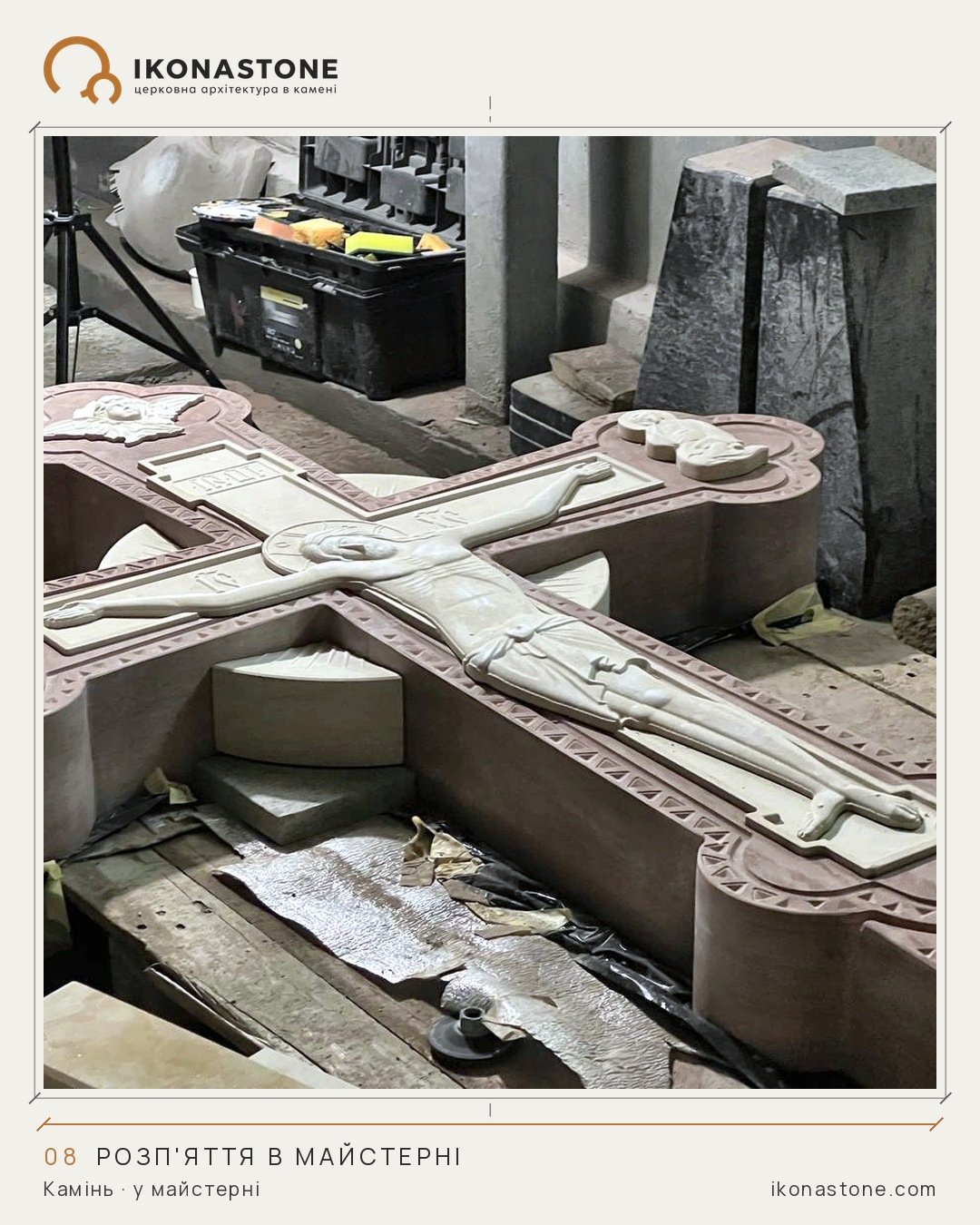
While a cross is in the workshop, it can be looked at in a way that will not be possible later. This stone Crucifixion lies flat, and one sees what cannot be seen once it is installed: the thickness, the side faces, the depth of the relief.
A stone cross with a relief: what is shown on it
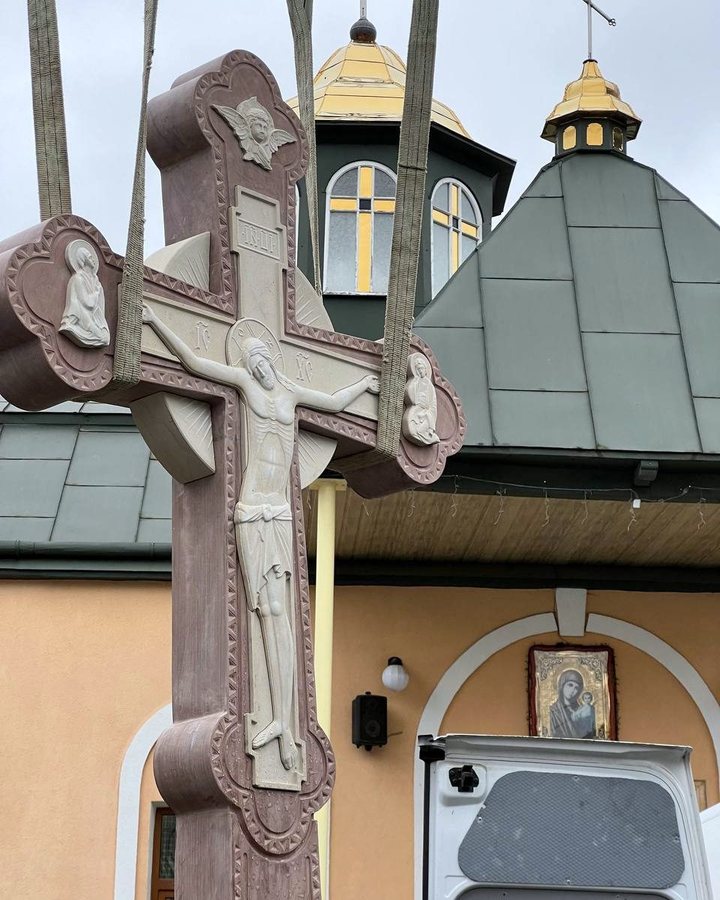
The figure of Christ is of pale stone; the background is darker. For this reason the silhouette reads at once, without prompting.
At the ends of the cross there are figures in relief, among them an angel. Along the edge runs a carved ornament: it holds the outline and gathers the composition into one whole.
A stone Crucifixion in the workshop: what is visible only here
From the front a cross is a silhouette. From the side it is thickness. When the piece stands in its place, what one mostly sees is the first.
In the workshop, while the cross lies flat, the eye travels along the stone. One sees how far the figure rises above the background, how the faces are worked, where the relief passes into the plane. This is the depth that disappears in a photograph taken from the front, and in stone it decides whether the relief will have shadow.
Bas-relief and high relief: what is the difference
Relief can be low or high. A bas-relief projects from the plane of the background by less than half its thickness. A high relief projects by more than half its volume; the parts that project most (heads, arms and legs) are often undercut so that they stand free of the background.
For the workshop this is not a question of terminology. Whether the Crucifixion in relief will be low or high determines the thickness of the stone, the depth of the shadow and how the figure reads from the side.
Making a stone cross: why a drawing is needed
Carving is work by subtraction: stone that has been removed cannot be put back. So the dimensions, the profile and the depth of the relief are agreed on the drawing, before the work begins.
The front view shows the silhouette. The section shows what the front does not: the thickness, the projection of the figure, the shape of the faces. It is the section that deserves the closest look.
What to decide before ordering
- Dimensions and thickness. A cross is seen not only from the front, even if the sketch makes it seem so.
- Profile and faces. What the side surface will be like and how the edge is worked.
- Relief depth. Low or high: the shadow depends on it.
- Combination of stones. A pale figure on a darker background is a decision made from the very beginning.
Questions and answers
What exactly does the drawing of a cross show? The dimensions, the profile and the depth of the relief. What cannot be changed in the finished piece can still be corrected on the drawing.
Can a pale and a dark stone be combined in one cross? Yes. On this Crucifixion a pale figure lies on a darker background, and it is the contrast that makes the silhouette stand out.
How does an order begin? With a photograph and the dimensions of the place. Then the sketch and drawing, approval, fabrication and installation.
If you are planning a cross for a church or its grounds, send us a photograph of the place and approximate dimensions and we will suggest the proportions and the depth of the relief: +380 66 892 98 18. More about this line of work is on the Crosses page.